Soil Water Potential vs Soil Moisture: Which Parameter Drives Smart Irrigation Best?
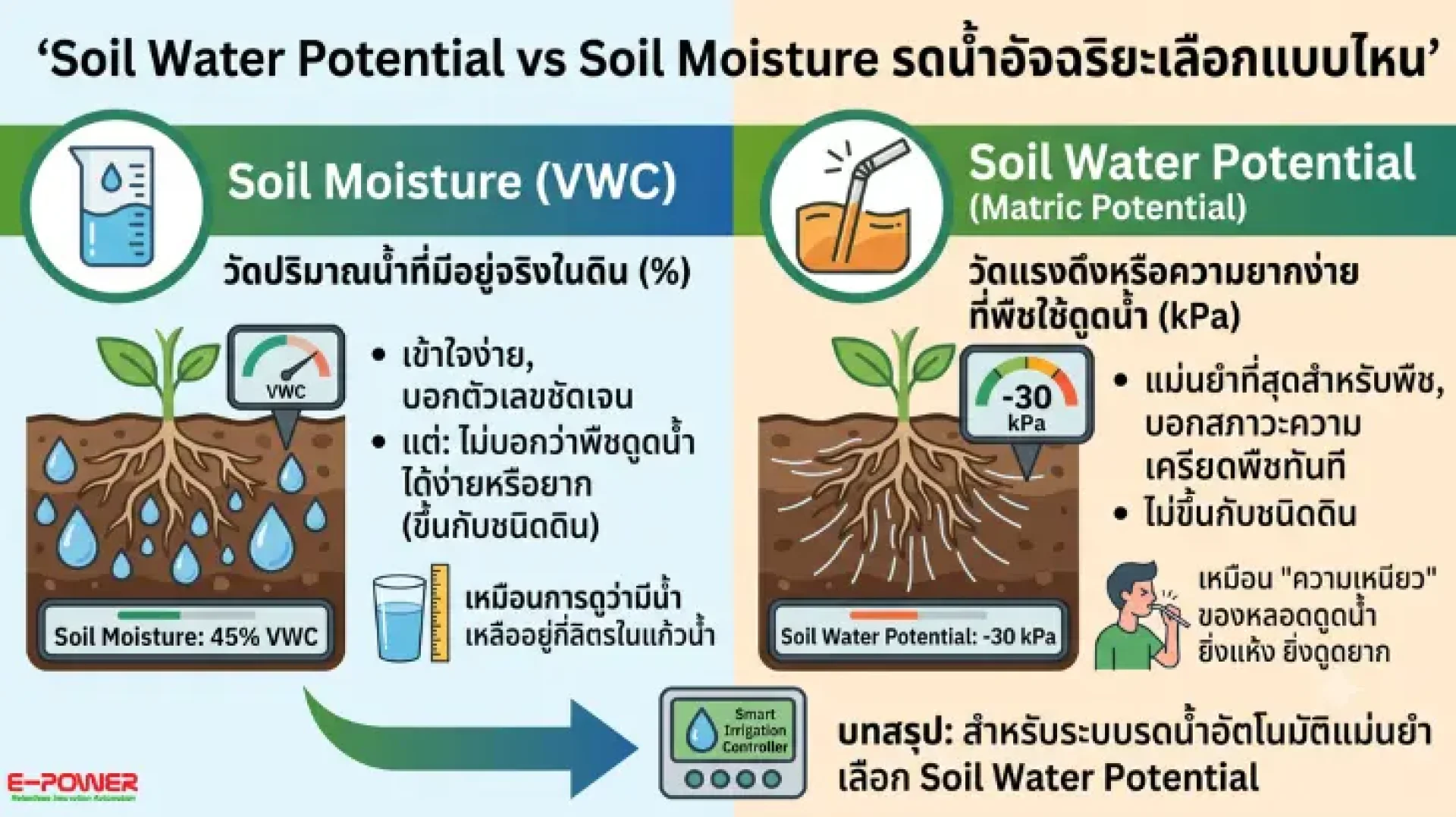
In the era of Smart Agriculture and automated farming, precision driving is key to sustainable crop yields and water conservation. When designing automated irrigation loops, engineers and agronomists frequently leverage soil sensors. However, a common technical crossroad appears: "Should we measure Soil Moisture (Volumetric Water Content) or Soil Water Potential (Matric Potential)?"
To optimize your automated setup, understanding how these two metrics impact plant physiology is crucial. At E-Power Service, we translate environmental data into industrial automation reality. Let's break down the science underneath the surface.
1.Understanding Soil Moisture (Volumetric Water Content - VWC)
Soil Moisture, typically quantified as Volumetric Water Content (VWC), measures the actual volume of water present within a given total volume of soil, expressed as a percentage (%).
- The Analogy: It tells you exactly how many milliliters of water are left inside a glass.
- Pros: Highly intuitive. It gives a direct, straightforward estimate of total water storage.
- Cons: Highly dependent on soil texture. A 20% VWC in coarse sand means the soil is saturated (wet). However, that same 20% VWC in heavy clay means the water is tightly bound to particles, leaving the soil effectively bone-dry and inaccessible to crops.
2. Understanding Soil Water Potential (Matric Potential)
Soil Water Potential—specifically Matric Potential—measures the energy state of water in the soil matrix. In layman's terms, it determines how hard a plant’s roots must work to pull water away from soil particles, measured in kilopascals (kPa) or Centibars.
- The Analogy: It measures the resistance or thickness of the straw the plant is drinking through. The drier the soil, the more negative the pressure becomes, meaning the plant experiences higher "Water Stress."
- Pros: Soil-Type Independent. A Matric Potential of -30 kPa indicates perfect water availability whether your crop is planted in sand, loam, or clay. It tells you exactly when the plant is happy or stressed.
- Cons: The metrics require technical understanding, as the values scale into negative integers (more negative equals drier soil).
Quick Comparison for Smart Farming Applications
| Metric | Soil Moisture (VWC) | Soil Water Potential (Matric Potential) |
| Measurement Target | Total volume of water (%) | Water availability/plant stress (kPa) |
| Soil Calibration | Requires unique calibration for every soil type | Works universally across different soil profiles |
| Data Interpretation | Shows how much water is there | Shows if the plant can actually use it |
| Best Application | Hydrological modeling, weather tracking | Smart Irrigation automation trigger loops |
The Verdict: The Smart Irrigation Champion
For automated Smart Irrigation Systems integrated via PLCs or IoT gateways, Soil Water Potential (Matric Potential) is the gold standard parameter. By triggering irrigation based on plant stress thresholds rather than arbitrary volumetric percentages, you avoid crop damage from over-watering and significantly minimize water waste across variable soil layouts.
Need to deploy professional smart farming architecture? E-Power Service (epower.co.th) provides premium industrial-grade agricultural sensors, telemetry data loggers, and automation logic engineering. Contact our engineering consultants today to implement high-yield precision automation!