Modbus RTU vs Modbus TCP: Detailed Protocol Comparison for Industrial Automation Systems
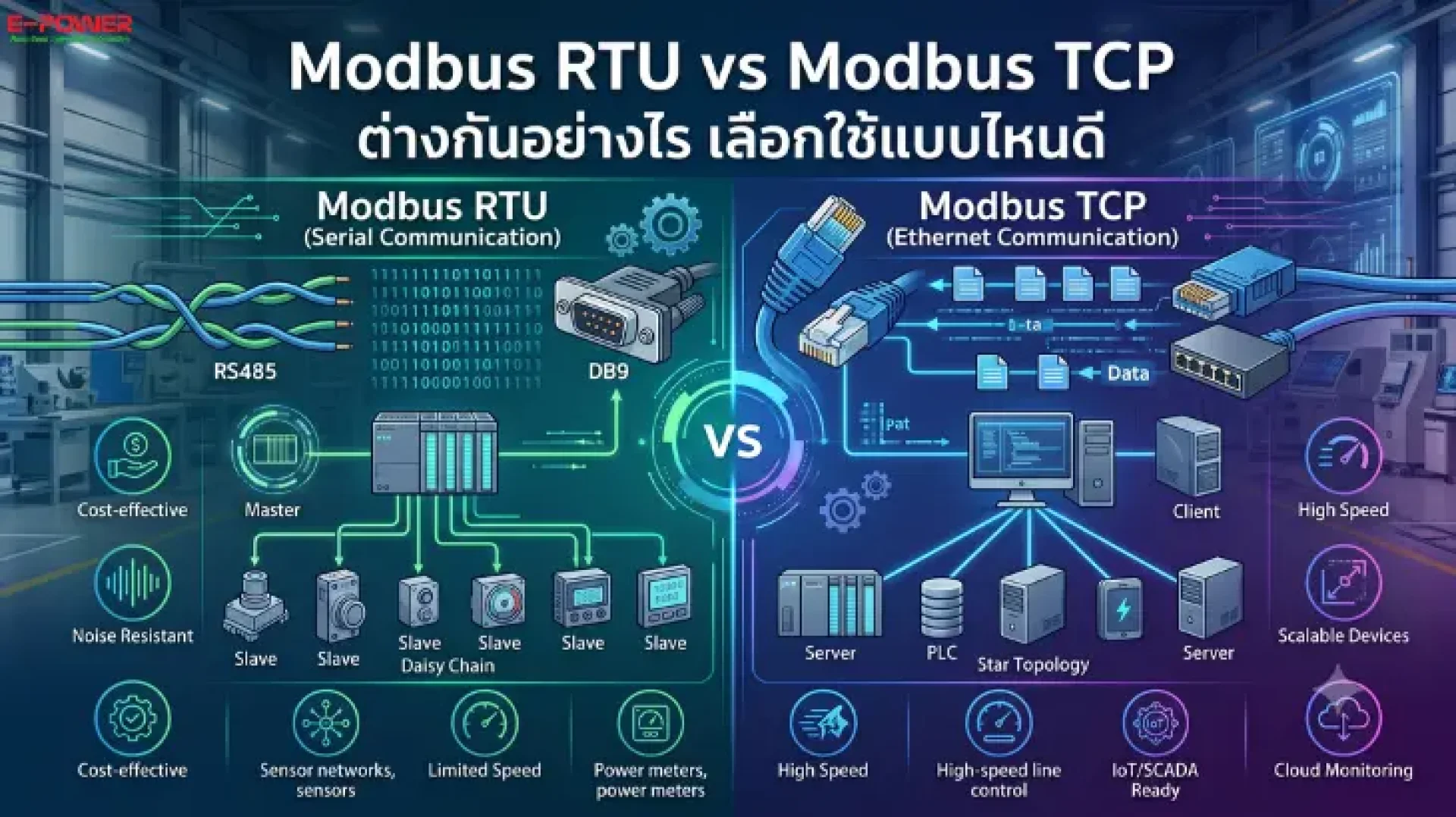
n the industrial automation sector, communication protocols function as the universal languages shared between machines. Among these, Modbus stands out as the global standard infrastructure. However, when engineers plan new communication frameworks, a fundamental question emerges: "What is the difference between Modbus RTU and Modbus TCP, and which one should we deploy?"
Selecting the correct architecture balances initial hardware budgets against long-term operational stability. At E-Power Service, we specialize in integrating complex field buses. Let's analyze the technical traits of both variants.
1. Understanding Modbus RTU (Serial-Based Communication)
Modbus RTU (Remote Terminal Unit) transmits data in clean binary formats over traditional serial network physical layers, most commonly utilizing the RS485 or RS232 hardware specifications.
How it Works: It relies on a deterministic Master/Slave topology (one central device polls peripheral units). Physically, devices are chained together sequentially from one to the next (Daisy Chain line topology) using a simple shielded twisted-pair wire.
Pros: * Extremely low deployment and cabling costs.
Exceptionally high noise immunity against heavy industrial electromagnetic interference (via RS485).
Universally supported by almost all legacy and modern industrial sensors.
Cons: Limited transmission velocities (typically peaking at 115,200 bps) and hard physical limits on device nodes per bus (standard max of 31 or 247 devices).
2. Understanding Modbus TCP (Ethernet-Based Communication)
Modbus TCP (Transmission Control Protocol) elevates the standard Modbus application protocol by encapsulating its data payload directly within standard TCP/IP network packets, running across standard Ethernet infrastructure.
How it Works: Operating via Client/Server dynamics (functionally matching Master/Slave), it incorporates common IT network components like industrial Switch Hubs and Routers. Each node is discretely identified via an assigned IP Address.
Pros:
High-Speed Datastreams: Achieves data rates from 100 Mbps up to Gigabit speeds—hundreds of times faster than serial variants.
Unlimited Scalability: Accommodates virtually limitless device configurations within network subnets.
Native Cloud & IoT Compatibility: Enables direct routing into local SCADA clients, analytical servers, or cloud platforms without data converters.
Cons: Higher initial network component hardware investments, and Ethernet cable runs are restricted to 100 meters per segment without active switches.
Technical Matrix: Modbus RTU vs Modbus TCP
| Parameter | Modbus RTU (Serial) | Modbus TCP (Ethernet) |
| Physical Medium | RS485 / RS232 copper cabling | LAN Cable (RJ45 / Cat5e / Cat6) / Fiber |
| Data Throughput Speed | Slower (9,600 - 115,200 bps typical) | High-speed (10/100/1000 Mbps) |
| Topology Style | Master / Slave (Linear Daisy Chain) | Client / Server (Star Topology via Switch) |
| Addressing Method | Slave ID integers (1 - 247) | IP Address configuration + Unit ID |
| Max Unbuffered Range | Up to 1,200 meters (via RS485 spec) | Up to 100 meters per Ethernet run |
- The Verdict: System Selection Engineering Guide
Deploy Modbus RTU if: Your project demands cost-effective field-level monitoring across localized nodes over long spans, such as environmental sensors in Smart Agriculture projects, wastewater treatment tank probes, or individual digital sub-meters installed throughout an MDB breaker panel. - Deploy Modbus TCP if: Your system demands rapid control loop updates, heavy data handshakes between multiple PLCs, or immediate, native pathways to push hardware analytics directly to modern cloud dashboards or enterprise SCADA solutions.
Note: If you have pre-existing Modbus RTU sensors but require an Ethernet uplink, a Modbus Gateway can easily translate the serial packets into TCP frames.
Looking to upgrade your plant's industrial data bus or implement high-tier PLC control loops? E-Power Service (epower.co.th) provides premium automation engineering, industrial-grade data architecture, and custom telemetry solutions. Contact our expert engineering team today to optimize your factory network!