4-20mA vs 0-10V vs RS485: Which Sensor Output Standard Captures Field and Environmental Telemetry Best?
4-20mA, 0-10V, and RS485 Modbus-RTU represent the primary industrial signaling output choices engineers confront when allocating liquid analytical sensors, soil arrays, or meteorological stations. In the deployment fields of Smart Agriculture and heavy-duty environmental monitoring, variable constraints like cable run distances, proximity to electromagnetic interference (EMI), and total sensor density directly dictate which electrical output format secures operational integrity.
The core systems design challenge is: "To build a highly stable and noise-immune sensor node network, which interface specification delivers peak engineering efficiency?" Today, E-Power Service (epower.co.th) structuralizes the technical breakdown to streamline your hardware selection.
Analyzing the 3 Primary Sensor Interface Specifications
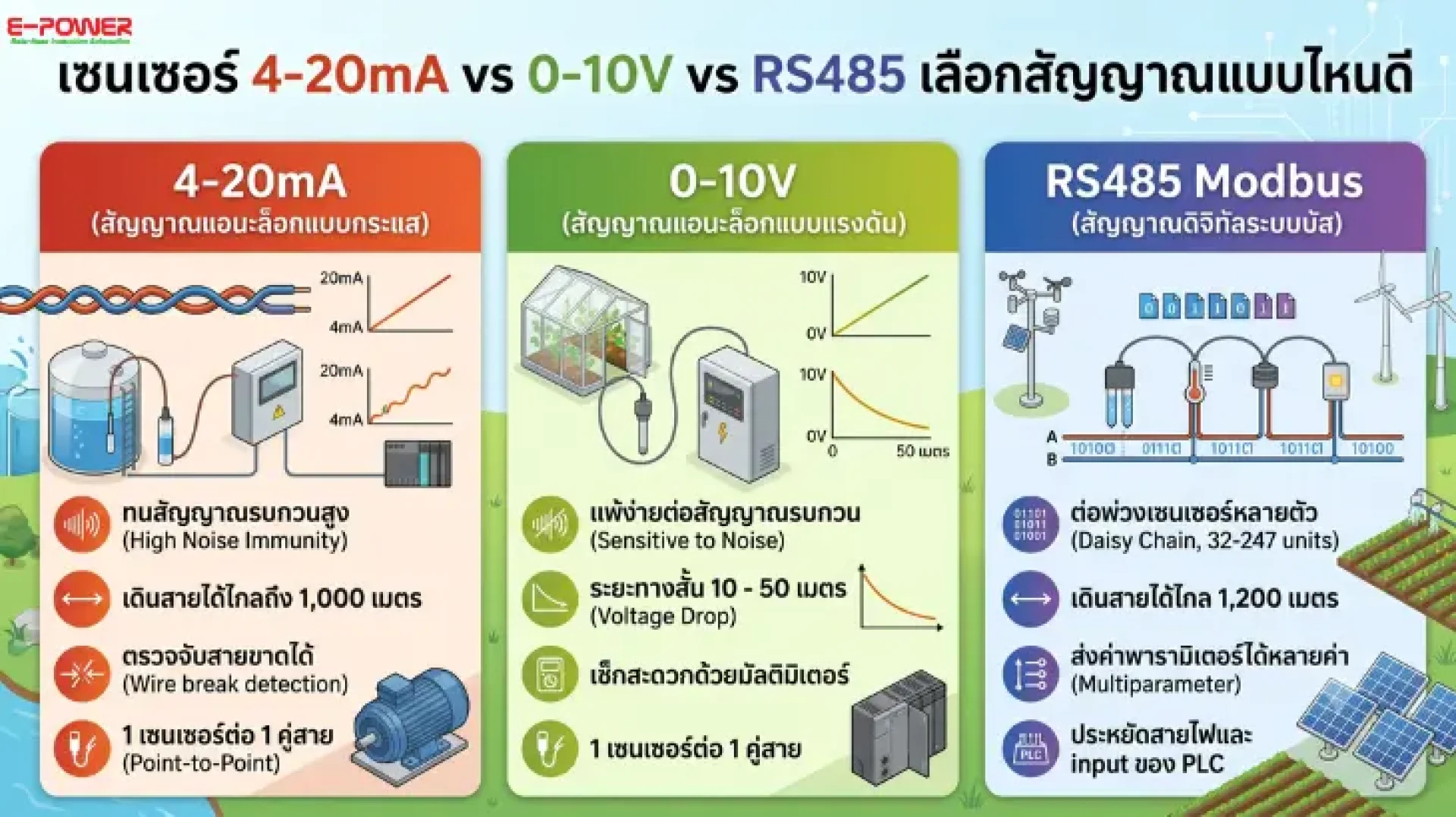
The 4-20mA Current Loop (Analog Current Standard)
A time-tested analog monitoring configuration where the physical variable is represented by varying levels of electrical current.
- How it Works: The field sensor actively regulates the loop current between a lower baseline of 4mA (minimum range value) and an upper bound of 20mA (maximum range value) back to the receiving PLC.
- Pros: Exceptional immunity to industrial noise. Because current magnitudes do not experience line degradation over long spans, it functions flawlessly over hundreds of meters. Additionally, it offers native line-fault monitoring; if a wire breaks, the current hits 0mA, prompting an immediate alert.
- Cons: Hardwired to a point-to-point physical layout (one dedicated wire pair per sensor element). High density arrays rapidly exhaust controller input module channels.
The 0-10V Signal (Analog Voltage Standard)
An analog signal format mapping physical sensor data directly across a linear voltage span.
- How it Works: The operational sensor unit expresses live telemetry by regulating its output potential dynamically between 0 Volts and 10 Volts.
- Pros: Highly intuitive setup engineering. Any field technician can diagnose and trace terminal anomalies immediately using a basic multimeter, with global hardware accessories pricing at an economical margin.
- Cons: Highly susceptible to EMI noise and Voltage Drop anomalies. When cable distances stretch beyond 10-50 meters, the copper wire resistance skews the true voltage reading, generating inaccurate controller telemetry.
RS485 Modbus-RTU (Digital Protocol Standard)
A robust, differential digital communication standard dominating modern automated control frameworks.
- How it Works: Data strings are packaged into tight digital binary structures, traveling across a single shielded twisted-pair wire bus (lines A and B) utilizing unique address IDs.
- Pros: Unmatched wiring conservation and extreme hardware scalability. Technicians can drop dozens of field sensors onto a linear daisy-chain bus architecture terminating into a single PLC serial input. It permits multi-parameter sensors to pipe distinct values simultaneously over a maximum range of 1,200 meters with zero accuracy decay.
- Cons: Requires engineering integration software configuration and micro-register mapping to properly parse the inbound digital hexadecimal frames.
Technical Comparison Matrix: Analog vs Digital Field Outputs
| Operational Metric | 4-20mA Current Loop | 0-10V Voltage Signal | RS485 Modbus-RTU |
| Signal Modality | Analog (Current) | Analog (Voltage) | Digital (Industrial Bus) |
| Noise & EMI Immunity | Extremely High | Low (Prone to distortion) | Extremely High (Differential) |
| Maximum Unbuffered Run | Up to 1,000 meters | Typically < 10 - 50 meters | Up to 1,200 meters |
| Sensor Node Density | 1 Node per loop layout | 1 Node per loop layout | Up to 32 - 247 Nodes per bus |
| Multi-Parameter Payload | Restrained (1 Value per loop) | Restrained (1 Value per loop) | Unrestricted (Multiple logs) |
The Application Verdict: Interface Selection Guide
- Deploy 4-20mA Outputs if: Your installation landscape demands standalone sensors positioned across significant remote distances flanked by massive electrical motors or pumps generating high EMI, such as liquid level trackers in raw industrial chemical vats or DO sensors in isolated wastewater aeration ponds.
- Deploy 0-10V Outputs if: The control application stays localized entirely inside small enclosure frameworks or confined residential greenhouses where cables remain short and clear of high-voltage conduits.
- Deploy RS485 Modbus-RTU if: Your project dictates a multi-node grid, such as a localized Weather Station or smart farming plot logging Soil Moisture, Air Temperature, and Solar Intensity across expansive acreage, or when routing unified analytical probes transmitting multi-parameter data linesvia a single cable connection.
Seeking to integrate clean telemetry across your next process or environmental engineering deployment? E-Power Service (epower.co.th) provides premium industrial instrumentation, advanced PLC controller systems, and full-spectrum automated data architecture. Contact our field application specialists today to customize your signal infrastructure layout!