RIKA RK200-03 Pyranometer: Class A/B/C Solar Radiation Sensor for Solar PV and Weather Stations
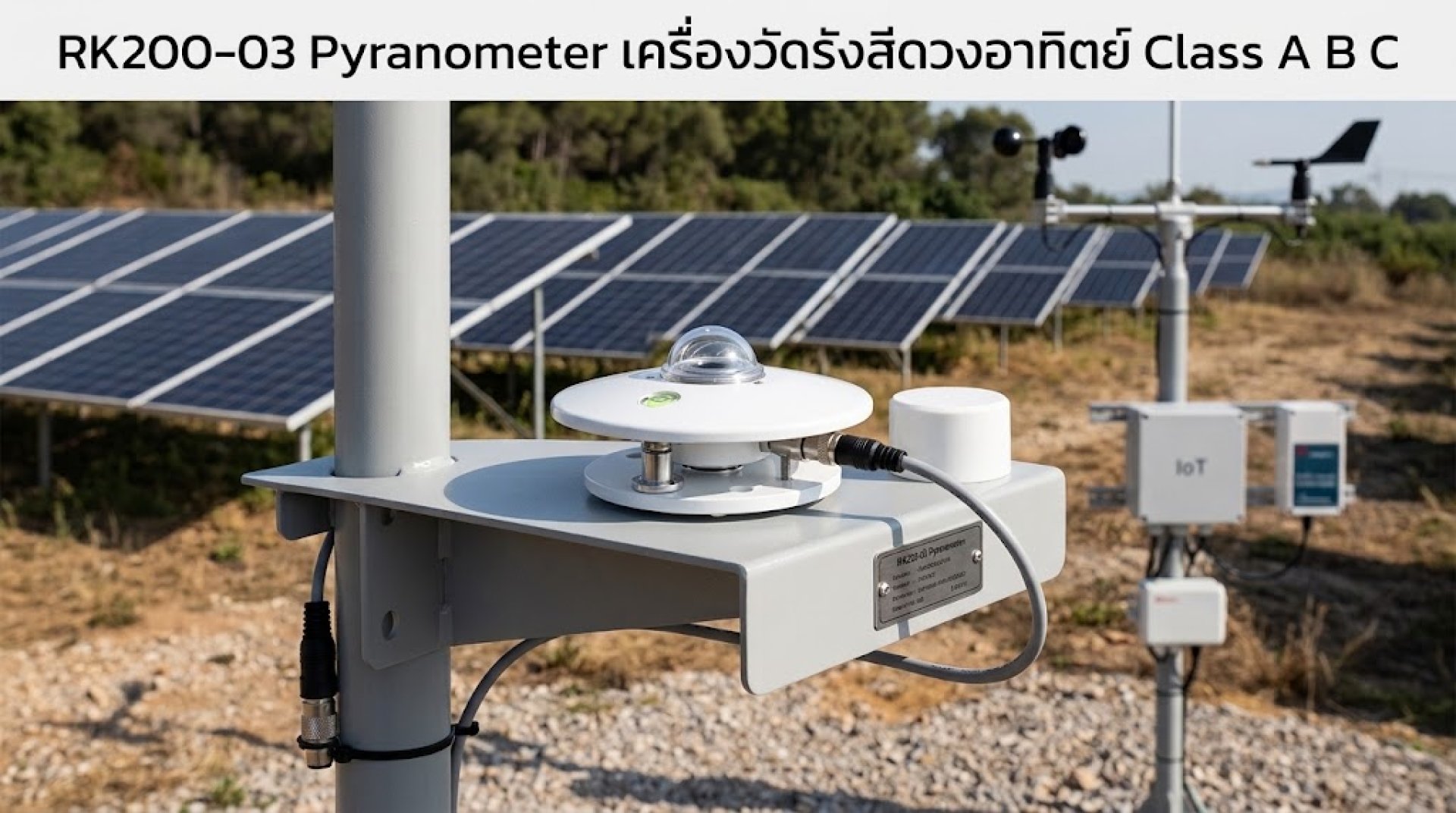
How do you know whether a solar farm or rooftop PV system is performing at full efficiency? First, you need to know how strong the sunlight actually was, and that is measured with a pyranometer, or solar radiation sensor. This article introduces the RIKA RK200-03 Pyranometer, which conforms to WMO and IEC 61724-1 standards, and explains how to choose between Class A, B, and C for your application.
What is the RK200-03? (Quick answer)
The RIKA RK200-03 is a pyranometer that measures solar radiation (sunlight intensity) in W/m². It is available in three accuracy classes, A, B, and C, with a measuring range of up to 04000 W/m² and a spectral range of 2803000 nm (Class A/B). Output options include 020mV, 420mA, and RS485 Modbus-RTU. With IP67 protection and an operating range of -40°C to +80°C, it is ideal for solar farms, weather stations, and agriculture.
Why do solar PV systems need to measure solar radiation?
The energy a PV array produces depends directly on how much sunlight it receives. Looking only at inverter output, you cannot tell whether a drop in production is caused by cloudy weather or by a problem with the system. A pyranometer lets you compare the sunlight received with the electricity produced, which allows you to
- Calculate the Performance Ratio (PR), the key performance indicator for solar plants
- Detect problems early, such as soiling, shading, inverter faults, or module degradation
- Plan panel cleaning and maintenance based on real data instead of fixed schedules
- Verify energy yield for PPA projects and performance guarantees
How is the Performance Ratio (PR) calculated?
PR is the ratio of the energy actually produced to the energy the system should produce given the sunlight it received. The closer the value is to 100%, the lower the system losses.
The irradiation value in this formula comes directly from the pyranometer, so the accuracy of the sensor determines the accuracy of the entire PR calculation.
Key features of the RIKA RK200-03 Pyranometer
Based on ISO 9060, calibrated per ISO 9847
Class A measures up to 4000 W/m², spectral range 2803000 nm
020mV, 420mA, RS485 Modbus-RTU, and SDI-12 depending on model
Operates from -40°C to +80°C, built for outdoor installation
Reduces thermal and wind effects for stable readings
Easy leveling and visual check of desiccant condition
RK200-03 specifications: Class A vs B vs C
| Item | Class A | Class B | Class C |
|---|---|---|---|
| Spectral Range | 2803000 nm | 2803000 nm | 3003200 nm |
| Output | 020mV / 420mA / RS485 | 020mV / 420mA / RS485 | 020mV / 420mA / RS485 / 05V (some models) |
| Supply | 1224VDC | 1224VDC | 1224VDC, 5VDC |
| Range | 04000 W/m² | 02000 W/m² | 02000 W/m² |
| Sensitivity | 714 μV/(W/m²) | 714 μV/(W/m²) | 714 μV/(W/m²) |
| Response Time (95%) | 15 s | 30 s | 60 s |
| Non-linearity | <±0.5% (1001000 W/m²) | ±1% (1001000 W/m²) | <±3% |
| Operating Temp. | -40°C to +80°C | -40°C to +80°C | -40°C to +80°C |
| Recalibration | Every 2 years | Every 2 years | Every 2 years |
| Calibration Basis | ISO 9847 | ISO 9847 | ISO 9847 |
Dimensions: 154 mm diameter, 101.5 mm height.
Class A, B, or C: which one should you choose?
Pyranometer classes are defined by ISO 9060 based on accuracy, linearity, and response time. The higher the class, the more accurate the measurement. General guidance:
Class A
Utility-scale solar farms, PPA projects, research, and monitoring systems requiring the highest accuracy under IEC 61724-1
Class B
Commercial and industrial rooftop PV and general weather stations, balancing accuracy and budget
Class C
Agriculture, greenhouses, smart farms, and environmental monitoring where trends matter more than precision
Applications of the RK200-03
- Solar PV power generation: monitor solar farm and rooftop performance and calculate PR
- Weather stations: record solar radiation alongside temperature, humidity, wind, and rainfall
- Agriculture and forestry: calculate evapotranspiration (ET) for precise irrigation planning
- Crop growth monitoring: control shade screens and greenhouse conditions
- Environmental monitoring and eco-tourism: collect long-term climate data
Pyranometer installation tips for accurate readings
| 1 | Choose a shade-free location with no trees, buildings, or poles blocking sunlight throughout the day |
| 2 | Level with the bubble indicator for global horizontal irradiance (GHI), or mount at the panel tilt (POA) for PR calculation |
| 3 | Point the cable toward the nearest pole: in the Northern Hemisphere, including Thailand, face the connector north to reduce solar heating of the connector |
| 4 | Maintain regularly: clean the glass dome, check the desiccant color through the window, and recalibrate every 2 years |
Integrating the RK200-03 into a solar monitoring system
The RS485 Modbus-RTU version of the RK200-03 connects directly to E-POWER's IoT Edge Gateway or FlowPLC, sharing the same bus as power meters and module temperature sensors. This enables automatic PR calculation, dashboard visualization, and LINE or Telegram alerts when system performance drops unexpectedly. The 420mA version connects easily to existing PLCs or data loggers.
RIKA RK200-03 Solar Pyranometer Radiation Sensor
View full product details and specifications, and ask which model best fits your project.
View product details Request a quoteFrequently asked questions (FAQ)
What is a pyranometer?
A pyranometer is an instrument that measures solar radiation falling on a surface, expressed in watts per square meter (W/m²). It is used in solar PV, weather stations, and agriculture.
What is the difference between RK200-03 Class A and Class B?
Class A measures up to 4000 W/m², responds within 15 seconds, and has non-linearity below ±0.5%. Class B measures up to 2000 W/m², responds within 30 seconds, and has ±1% non-linearity. Class A is best for projects requiring the highest accuracy.
Can the RK200-03 send data to a PLC or SCADA?
Yes. The RK200-03 supports 420mA, 020mV, and RS485 Modbus-RTU outputs depending on the model, so it connects directly to PLCs, SCADA, data loggers, and IoT gateways.
How often should a pyranometer be calibrated?
The RK200-03 should be recalibrated every 2 years per ISO 9847. The glass dome should also be cleaned and the desiccant checked regularly.
Need solar radiation measurement or solar monitoring?
E-POWER engineers can help you choose the right class, then design, install, and integrate monitoring systems for solar farms, rooftop PV, and weather stations.
LINE: @epower info@epower.co.thTel. +66 81-559-5145 | YouTube: Epower Service | TikTok: epowerservice_