Submersible Water Level Sensors for Ponds, Tanks, and Boreholes
LEVEL MEASUREMENT GUIDE
Submersible Water Level Sensors for Ponds, Tanks, and Boreholes
How they work, how to choose range and materials, and how to install them in boreholes for accurate readings and pumps that never run dry.
Quick answer: what is used to measure water level in a borehole?
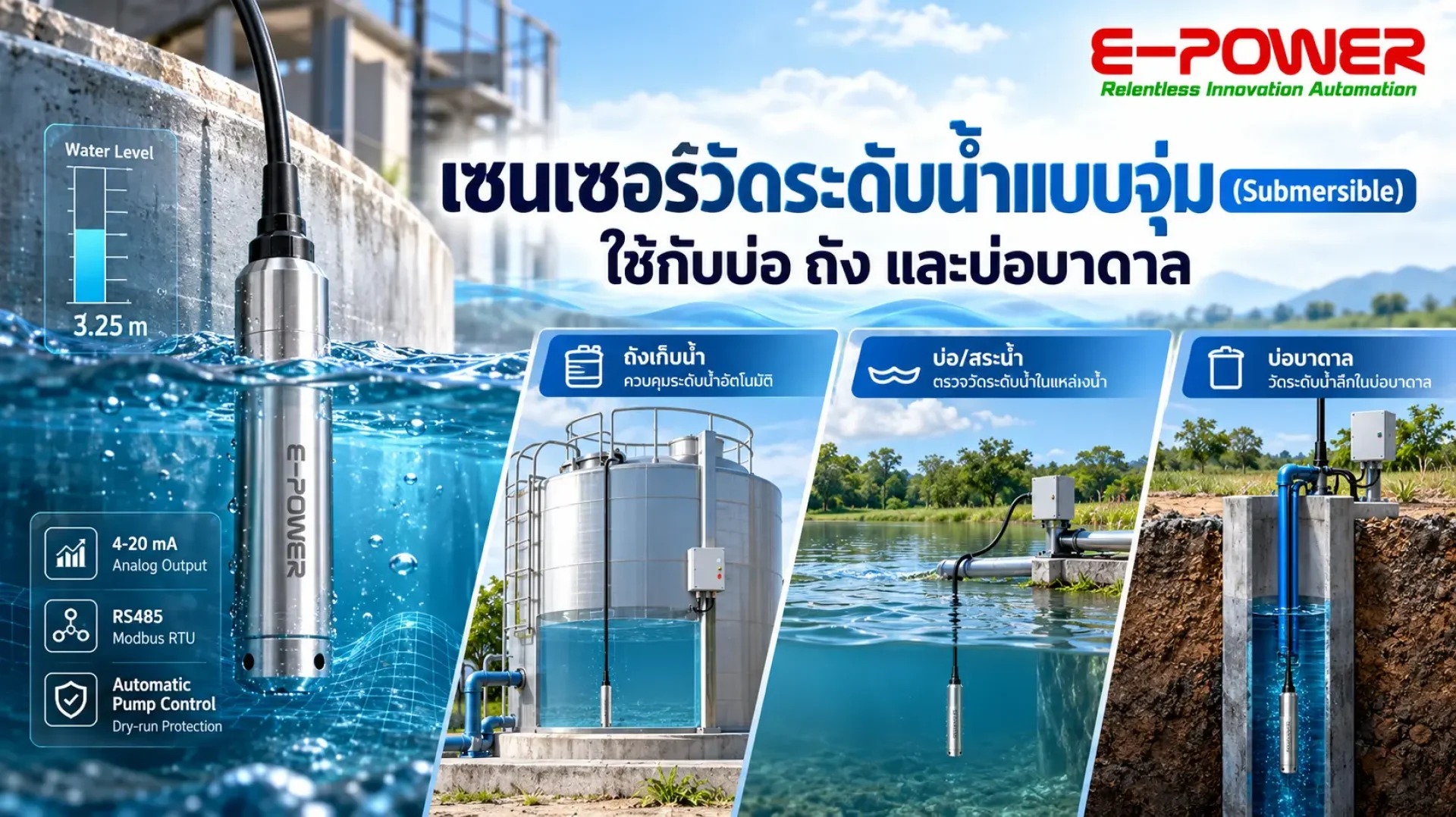
The usual choice is a submersible level transmitter. It is lowered into the well and measures the pressure of the water above the sensor, which rises by about 9.81 kPa for every metre of depth, so it converts directly into water level. It suits boreholes because the sensor is slim enough for narrow casings and isn't affected by well walls or pump pipes the way ultrasonic sensors are. With 420mA and RS485 Modbus-RTU outputs, it serves both groundwater monitoring and pump dry-run protection.
01
How does a submersible water level sensor work?
A submersible sensor is a pressure sensor designed to stay underwater permanently. The deeper it sits, the more water presses down on it, so the measured pressure corresponds directly to the height of water above it, following the principle of hydrostatic pressure.
Water level (h) = Pressure (P) ÷ (Water density ρ × Gravity g)
For fresh water: 10 kPa about 1.02 m of water depth
Note that the reading depends on liquid density. In seawater or wastewater, which are denser than fresh water, the density setting must be adjusted, or the indicated level will read slightly high.
Why does the sensor cable have an air tube?
The water surface is also pushed down by atmospheric pressure, which changes with the weather. Most submersible sensors are therefore gauge pressure types with a small vent tube running up the cable to the top end. This cancels atmospheric pressure automatically, giving the true water level. The vent end must stay open to air, never blocked or wet, ideally inside a weatherproof box with desiccant.
02
Where are they used?
| Application | Benefit |
| Boreholes | Track groundwater level at rest and while pumping, prevent pump dry-running, and assess whether the well still yields enough water |
| Water storage tanks | Automatic refill pumping and alerts for low level or overflow |
| Holding and aquaculture ponds | Control pond levels and plan filling and water exchange |
| Wastewater sumps | Alternate duty pumps by level and prevent sump overflow |
| Canals, rivers, reservoirs | Monitor water levels and issue flood warnings when installed in a protective tube on the bank |
03
Submersible vs other level sensors
| Topic | Submersible | Ultrasonic | Radar | Float |
| Principle | Pressure under water | Sound waves from above | Microwaves from above | Point switches |
| Narrow boreholes | Ideal | Poor, echoes off walls | Very limited | Only fixed points |
| Continuous reading | Yes | Yes | Yes | No |
| Contact with water | Yes | No | No | Yes |
| Main limitation | Vent tube care, sediment buildup | Vapor, foam, wind | Higher cost | Sticking, wear |
For open tanks or applications where the device shouldn't touch the liquid, such as greasy wastewater, a radar sensor may be a better fit. For boreholes and narrow pipes, a submersible sensor is the go-to choice.
04
How to choose a submersible water level sensor
| Parameter | Recommendation |
| Measuring range | Cover the maximum water depth above the sensor with about 2030% margin. Don't oversize it, since accuracy is a percentage of full scale |
| Accuracy | Typically ±0.250.5% of full scale; on a 10 m range that means about 2.55 cm |
| Sensor diameter | For boreholes, small enough to fit between the casing and pump riser, or inside a prepared sounding tube |
| Body material | 316L stainless steel for general water; titanium or special materials for seawater and corrosive liquids |
| Cable | Built-in vent tube, rated for continuous immersion, able to carry its own weight, and long enough from wellhead to sensor depth |
| Sensing face | Standard ports suit clean water; for wastewater or silty water, choose a flush diaphragm that resists clogging |
| Output signal | 2-wire 420mA handles long cable runs well; RS485 Modbus-RTU allows multiple points on one cable and often reports temperature too |
| Ingress protection | IP68, rated for immersion depth matching the measuring range |
05
Borehole installation tips
A borehole has two key levels: the static water level when not pumping, and the lower pumping water level while the pump runs. The sensor must cover both.
- Set the sensor below the lowest pumping level so it is always submerged, but not right next to the pump intake, where suction and turbulence make readings fluctuate
- Use a sounding tube: a small PVC pipe lowered beside the pump riser, with the sensor inside it, prevents tangling with the riser and power cable and makes removal for inspection easy
- Secure the cable at the wellhead with a cable clamp so the sensor stays at a fixed depth and never sinks into mud at the bottom
- Set the depth offset: record the installation depth from the wellhead so the system can report depth to water from ground level, the standard figure in groundwater monitoring
- Terminate the cable and vent tube in a weatherproof box with a breather and desiccant, and never seal the vent end
- Add surge protection: cables running from an outdoor well to the control panel should have surge protection and proper grounding
For tanks and holding ponds
Install the sensor in a stilling tube perforated at the bottom and positioned away from the inflow, so splashing and surface waves don't cause fluctuations. Raise the sensor slightly off the bottom to avoid sediment.
06
Common problems and fixes
| Symptom | Common cause |
| Reading drifts with the weather | Vent tube blocked or wet, so atmospheric pressure is no longer compensated |
| Fluctuates while the pump runs | Sensor too close to the pump intake or inflow; relocate it or use a sounding tube |
| Stuck or slowly drifting value | Sediment or scale on the sensing face; remove and clean periodically |
| No reading after a storm | Lightning surge damaged the electronics; install an SPD |
| Level reads higher than actual | Used in a liquid denser than fresh water without adjusting the density setting |
07
Turn level data into automatic pump control with E-POWER
Submersible level readings can do far more than display a number. E-POWER's FlowPLC and IoT Edge Gateway read both 420mA and RS485 Modbus-RTU and put the data to work:
- Borehole dry-run protection: stop the pump when the level falls below a setpoint and restart when the well recovers
- Automatic tank filling: start the refill pump at low level and stop when full
- Inverter control: vary pump speed to hold level or pressure and save energy
- Logging and alerts: keep level trend history and send LINE or Telegram alerts on low water or lost sensor communication
Frequently asked questions
What is used to measure water level in a borehole?
A submersible level sensor, which measures the water pressure above the sensor and converts it to level. It fits narrow casings and reads continuously.
How does a submersible water level sensor work?
It measures the hydrostatic pressure of the water above it, which rises about 9.81 kPa per metre of depth, and calculates water level from that.
Why does a submersible sensor cable need a vent tube?
To cancel the atmospheric pressure acting on the water surface, so the reading reflects true water level and doesn't drift with the weather. The vent end must stay open and dry.
What measuring range should I choose?
Cover the maximum water depth above the sensor with about 2030% margin, and avoid oversizing, since error is calculated as a percentage of full scale.
Can a submersible sensor be used in wastewater?
Yes, with a clog-resistant flush diaphragm, corrosion-resistant materials, and regular cleaning. For very greasy wastewater, a radar sensor may be more suitable.
Need water level monitoring and automatic pump control?
E-POWER engineers can help you choose the right sensor for your wells and tanks, plan the installation, and connect pump control with mobile alerts.
Talk to us on LINE @epower info@epower.co.thTel. +66 81-559-5145 · YouTube: Epower Service · TikTok: epowerservice_