Reservoir Water Level and Rainfall Station: Radar and Rain Gauge on a Single Pole
HYDROLOGY MONITORING
Reservoir Water Level and Rainfall Station: Radar and Rain Gauge on a Single Pole
Rain is the cause and water level is the result. Measuring both at one station shows in advance how fast the reservoir will rise, so release decisions can be made in time.
A water level and rainfall station is a basic tool for managing reservoirs, weirs, and community water sources. Yet many sites still read a staff gauge once a day and have no rainfall data from the catchment at all. This article explains why rainfall should be measured alongside water level, how to choose the sensors, and how to design a self-sufficient single-pole station running 24 hours a day with the Supmea SUP-WSR310 radar level sensor and the RIKA RK400-01 rain gauge.
why measure rainfall together with reservoir water level?
Because rainfall tells you in advance that water is coming, while water level tells you how much has already arrived. Recording both shows how many centimeters a given rainfall raises the reservoir and how many hours it takes. This helps forecast water levels, plan releases before overflow, and issue flood warnings earlier. A single-pole water level and rainfall station does all of this with solar power and real-time data transmission.
01
Why measure rainfall together with water level?
| What the data shows | How it helps |
| Heavy rain, level not yet rising | Runoff is on its way from the catchment; prepare before the level actually rises |
| Same rain, different rise | Early in the season dry soil absorbs much of the rain; late in the season saturated soil makes even light rain raise levels quickly |
| Level rising without rain | Possible upstream inflow or releases from elsewhere; worth investigating |
| High intensity in a short time | A flash flood warning sign; set alert thresholds in millimeters per hour |
| Years of historical data | Build the reservoir's rainfall-level relationship to plan storage and dry-season allocation |
02
Components of a single-pole water level and rainfall station
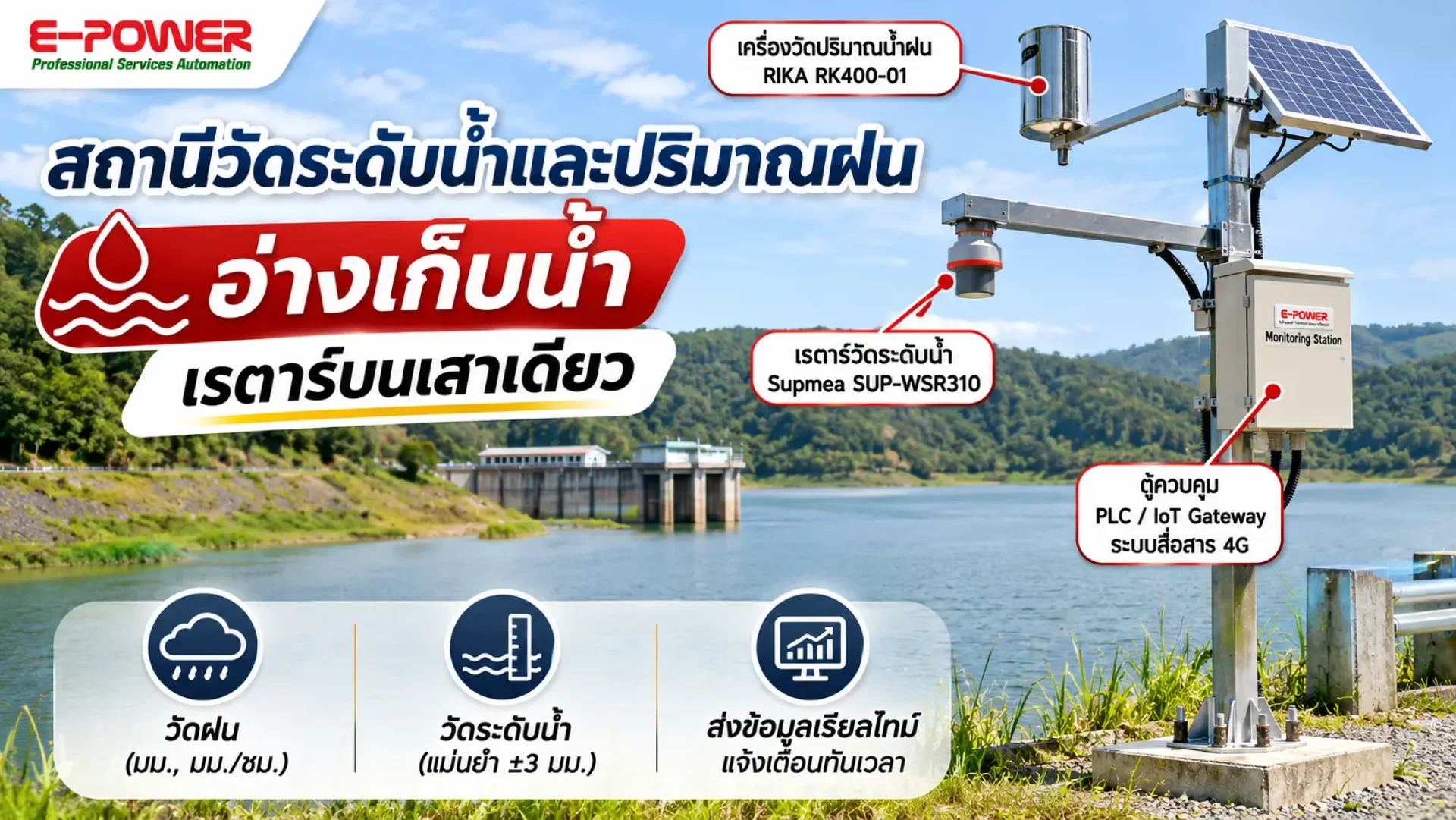
Putting all sensors on one pole lets the water level and rainfall station share a single control cabinet, power supply, and communication system, reducing civil works and cabling costs.
Station layout
Pole top
Solar panel, and the rain gauge on an open arm
Arm over the water
Radar level sensor pointing straight down at the surface
Control cabinet
PLC or IoT gateway, battery, charge controller, and 4G communications
Protection
Earthing and surge protection for RS485 and power lines
03
Why use radar to measure reservoir water level?
Radar beams a signal at the water surface and measures distance from the echo time, then calculates water level = installation height - measured distance. Compared with other sensors in reservoir applications:
| Topic | Radar | Submersible | Ultrasonic |
| Water contact | None | Always submerged | None |
| Sediment and debris | Unaffected | Sediment buries the probe, debris tangles the cable | Unaffected |
| Rain, fog, wind, temperature | Minimal effect | Unaffected | Sound speed varies with temperature and wind |
| Maintenance | Very low | Periodic removal and cleaning | Low |
For a water level and rainfall station, an 80 GHz radar like the SUP-WSR310 has a narrow 6-degree beam, so it rarely picks up echoes from the pole or nearby banks, making it ideal for mounting on an arm extending from a reservoir-side pole.
04
How does a tipping bucket rain gauge work?
Rain enters a 200 mm collector and flows into a tipping bucket calibrated to tip every 0.2 mm of rainfall. Each tip sends one pulse, and the other side of the bucket moves into place to keep collecting. The system counts tips to calculate accumulated rainfall and rainfall intensity in millimeters per hour from the number of tips in a time period, the most important data a water level and rainfall station provides for flash flood warning.
Caution when mounting the rain gauge on the same pole as the radar
The rain gauge must sit in the open, with no solar panel, sign, or part of the pole blocking it or dripping into the collector. Mount it on a separate arm or the pole top, level it with the spirit level at the base, and fit bird spikes so droppings don't clog the filter.
RECOMMENDED PRODUCTS
Sensors for water level and rainfall stations from E-POWER
Supmea SUP-WSR310 Radar Water Level Sensor
| Principle | 80 GHz FMCW radar, non-contact |
| Range | 0-15 m |
| Accuracy | ±3 mm |
| Beam angle / blind zone | 6 degrees / 0.2 m max |
| Output / power | RS485 / 9-36 VDC |
RIKA RK400-01 Tipping Bucket Rain Gauge
| Collector / resolution | Ø200 mm / 0.2 mm per tip |
| Rainfall intensity | Measures up to 4 mm/min (withstands up to 10 mm/min) |
| Accuracy | ±4% (tested at 2 mm/min intensity) |
| Output | Reed switch pulse or RS485 Modbus-RTU (12-24 VDC supply) |
| Materials / weight | 304 stainless steel collector, ABS bucket / 3.5 kg |
| Options | Removable filter, bird spikes, and heating |
05
Installing a water level and rainfall station at a reservoir
- Set the pole at the water's edge with the radar arm over the water, clear of the bank and vegetation, so the beam hits the surface directly at every level
- Calculate installation height from the maximum level: the highest flood level must stay farther from the radar face than the 0.2 m blind zone, and the lowest level must remain within the 15 m range
- Reference a datum: survey the installation height against the reservoir's benchmark or staff gauge so readings match existing records
- Place the control cabinet on the bank above flood level and orient the solar panel for full sun without shading the rain gauge
- Assign unique RS485 slave addresses: many sensors ship with address 1, so set distinct addresses before connecting them on one line
- Earth the pole and fit surge protection; exposed waterside poles face a high lightning risk
- Clean the rain gauge filter regularly so leaves and insects don't block it
06
E-POWER water level and rainfall station systems
- Supmea and RIKA distributor: full supply of radar level sensors, rain gauges, and other weather sensors
- EC201S PLC, Haiwell PLC, or FlowPLC reads sensors over RS485 Modbus-RTU and calculates water level, daily accumulated rainfall, and hourly intensity
- Solar power and 4G communications for self-sufficient remote operation, with local logging when the signal drops
- HMI screens and dashboards showing rainfall against water level, with LINE or Telegram alerts when level or intensity exceeds thresholds
- Complete design and installation, from pole, arms, and cabinets to sensor verification before handover
Frequently asked questions about water level and rainfall stations
Why measure rainfall together with reservoir water level?
Rainfall gives advance notice that water is coming, while water level shows the result. Together they enable level forecasting, release planning, and earlier flood warnings.
How does a radar level sensor calculate water level?
It measures the distance from the sensor face to the water surface; subtracting that from the installation height gives the water level.
Can a tipping bucket rain gauge measure rainfall intensity?
Yes, by counting tips over a time period. The RK400-01 tips every 0.2 mm, so the system can calculate millimeters per hour.
Can the rain gauge and radar share one pole?
Yes, as long as the rain gauge is in the open, not shaded by the solar panel or pole, and installed level.
Can the station run where there is no grid power?
Yes, using solar panels and batteries with 4G data transmission and local logging during signal loss.
Need a water level and rainfall station for your reservoir?
E-POWER engineers can survey your site, design the pole and control cabinet, select sensors, install everything, and set up mobile alerts end to end.
Talk to us on LINE @epower info@epower.co.thTel. +66 81-559-5145 · YouTube: Epower Service · TikTok: epowerservice_
Related articles: Radar water velocity sensors · Submersible water level sensors · Surge protection for RS485 · EC201S small CODESYS PLC · LoRaWAN vs NB-IoT vs 4G
Reference: www.rikasensor.com, www.supmea.com