What is a Load Cell & Weighing Indicator? Industrial Weighing Systems for Batching, Filling, and Silos
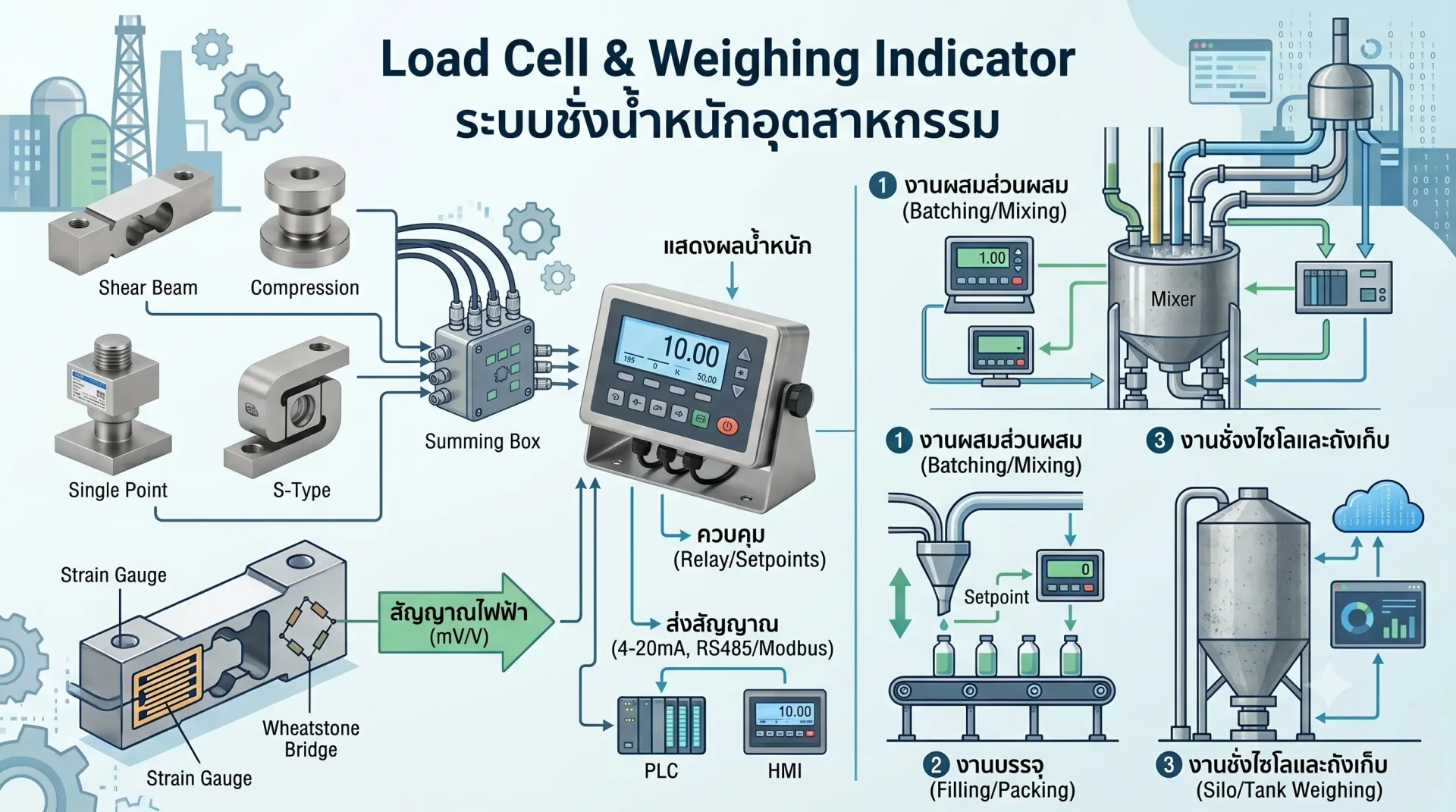
Load Cell & Weighing Indicator: What is the difference, how do they function together as an industrial weighing system, and why are they critical for automated batching, filling, and silo operations? In manufacturing facilities, weight precision directly impacts product quality and your bottom line. Whether you are mixing raw materials according to strict formulas, filling packagings to precise targets, or auditing bulk inventories inside industrial silos, physical accuracy is paramount. A Load Cell acts as a specialized sensor that converts physical force or weight into electrical signals, while a Weighing Indicator functions as the electronic brain that interprets those signals, displays the numeric values, and triggers automation commands. Together, they form an integrated industrial weighing system essential for factory automation. This article delivers a comprehensive guide on how these components operate, their common types, and how to select the right setup for your facility.
How Does a Load Cell Work?
Inside an industrial Load Cell is an array of strain gauges bonded directly to a structural metal element. When a physical weight or force is applied to the load cell, the metal body deflects ever so slightly, causing a proportional change in the electrical resistance of the strain gauges. An integrated Wheatstone bridge circuit converts this resistance shift into a low-voltage electrical signal (typically measured in mV/V) that correlates directly to the applied weight. This raw micro-volt signal is then transmitted down the line to a Weighing Indicator for filtering, digital processing, and live numerical display.
Common Types of Industrial Load Cells:
- Single Point: Ideal for bench scales, counting devices, and compact platform scales.
- Shear Beam: Designed for industrial floor scales, mixing tanks, and automated batching systems.
- Compression (Canister): Engineered for massive high-capacity structures, heavy-duty vehicle scales, and bulk storage silos.
- S-Type (Tension): Perfect for hanging crane scales, tensile strength testers, and suspended hopper systems.
What Does a Weighing Indicator Do?
An industrial Weighing Indicator is far more than a simple visual display screen. It acts as a dedicated controller that processes signals, runs system calibrations, and directly controls upstream/downstream machinery through physical hardware outputs.
Key capabilities found in industrial-grade weighing indicators include:
- Setpoints and Relay Outputs: Allows users to establish target weight boundaries, triggering physical relays to instantly cut off material feeds once a threshold is reached (e.g., automated pouch or container filling).
- Batching Sequence Automation: Sequentially dispenses multiple raw ingredients into a single blending vessel based on preset chemical or material formulas.
- Analog Output Retransmission: Converts the digital weight calculation into standard 4-20mA or 0-10V analog loops to stream data to PLCs.
- Digital Bus Communication: Utilizes embedded RS232 or RS485 communication channels running standard Modbus RTU protocols to link into local SCADA software or remote IoT networks.
- Advanced Firmware Features: Includes algorithms for automated zero tracking (Auto Zero), check-weighing logic, and under/over alarms.
Core Infrastructure of an Industrial Weighing System
A standard automated industrial weighing architecture connects sequentially in the following order:
Load Cell (Single or Multiple) -> Junction / Summing Box -> Weighing Indicator -> PLC / HMI / IoT Gateway
In scenarios utilizing multiple load cells—such as an industrial storage silo supported by three or four legs—the raw signals from each load cell must pass through a Summing Box first. This junction box combines and averages the independent millivolt signals into a single unified feed before passing it to the Weighing Indicator. The indicator computes the final mass value and forwards it to overarching automation controls to manage valves, conveyor lines, or upload weight datasets to cloud servers.
Primary Industrial Applications
1. Batching and Mixing Operations
Accurately weighs and dispenses various raw ingredients into a blend based on pre-programmed batch formulas. This is a crucial automation standard for food processing, chemical compounding, cement plants, and concrete batching facilities to maintain product uniformity across every production lot.
2. Filling and Packaging Automation
Controls liquid or dry bulk filling lines to ensure packages hit exact weight targets. Using automated setpoints, the system triggers fast-acting valves or feed screws to stop filling instantly when the weight limit is met, eliminating material giveaways and packaging overflows.
3. Silo and Storage Tank Weighing
Measures bulk materials stored inside massive silos or tanks by treating the entire structure as a scale. This provides managers with real-time inventory tracking, prevents material stockouts, and simplifies supply chain fulfillment scheduling.
How to Choose the Right Load Cell and Weighing Indicator
- Total System Capacity: Calculate the combined maximum load of your structure, including tare weight, and add a safety margin to prevent structural cell damage.
- Mechanical Mounting Requirements: Match the load cell form factor (e.g., shear beam, canister, or S-type) to your structural design.
- Number of Support Points: Determine if your system requires a multi-cell framework, which will require an industrial summing box.
- Control Functionality: Decide if your indicator needs built-in multi-ingredient batching logic, simple check-weighing, or just basic display capabilities.
- Network and Protocol Integration: Confirm that your indicator supports the required outputs, such as 4-20mA analog loops or RS485 Modbus RTU.
- Environmental Resistance: Check the IP rating (e.g., IP67/IP68 stainless steel) to ensure components can survive washdown wash-outs, acidic materials, or extreme dust.
Recommended Industrial Sensor and Indicator Models
- SYMC BC360L Weighing Indicator
A cost-effective, high-performance industrial weighing controller equipped with robust built-in control functions. Features include integrated setpoint comparison loops, automated material transfer controls, over/under limit alarms, 4-20mA or 0-10V analog outputs, and dual RS232/RS485 communication ports running standard Modbus RTU. It is an excellent fit for general batching, filling, and tank systems. - SYMC BC360C Weight Transmitter
A compact DIN-rail mount weighing transmitter engineered for multi-scale control rooms where enclosure space is limited. It converts raw load cell signals into standard industrial fieldbus communication protocols, combining local diagnostics with long-distance signal transmission. - E-Power Loadcell Indicator EP3101-K
A high-accuracy weight indicator designed to interface seamlessly with industrial summing boxes for multi-load cell architectures. It easily connects to giant scoreboard displays, PLCs, and HMI units, and it can display real-time weight parameters on mobile devices via modern IoT telemetry interfaces.
Frequently Asked Questions
Q: What is the difference between a Load Cell and a Weighing Indicator?
A: A load cell is the physical sensor that deflects under a load to generate a small electrical signal. A weighing indicator is the processing device that receives this electrical signal, converts it into a digital weight value, and triggers automation relays.
Q: Why is a summing box required in multi-load cell systems?
A: When an industrial tank or silo sits on multiple load cells, each cell outputs an independent signal. A summing box parallel-connects these individual signals, balances variations, and sends a single averaged output to the indicator for accurate processing.
Q: Can an industrial weighing indicator control machinery directly without a PLC?
A: Yes. Advanced indicators like the SYMC BC360L feature built-in hardware relay outputs and setpoint logic. They can directly start or stop feed valves and conveyor belts based on target weight thresholds without needing an overarching PLC.
Q: What communication protocols do industrial weighing indicators use?
A: Most professional indicators utilize standard RS485 or RS232 hardware channels running Modbus RTU protocols, enabling simple integration into PLCs, HMI systems, SCADA platforms, and modern IoT cloud boxes.