4-20mA vs. RS485 (Modbus) vs. 0-10V: Sensor Signal Differences and Selection Guide
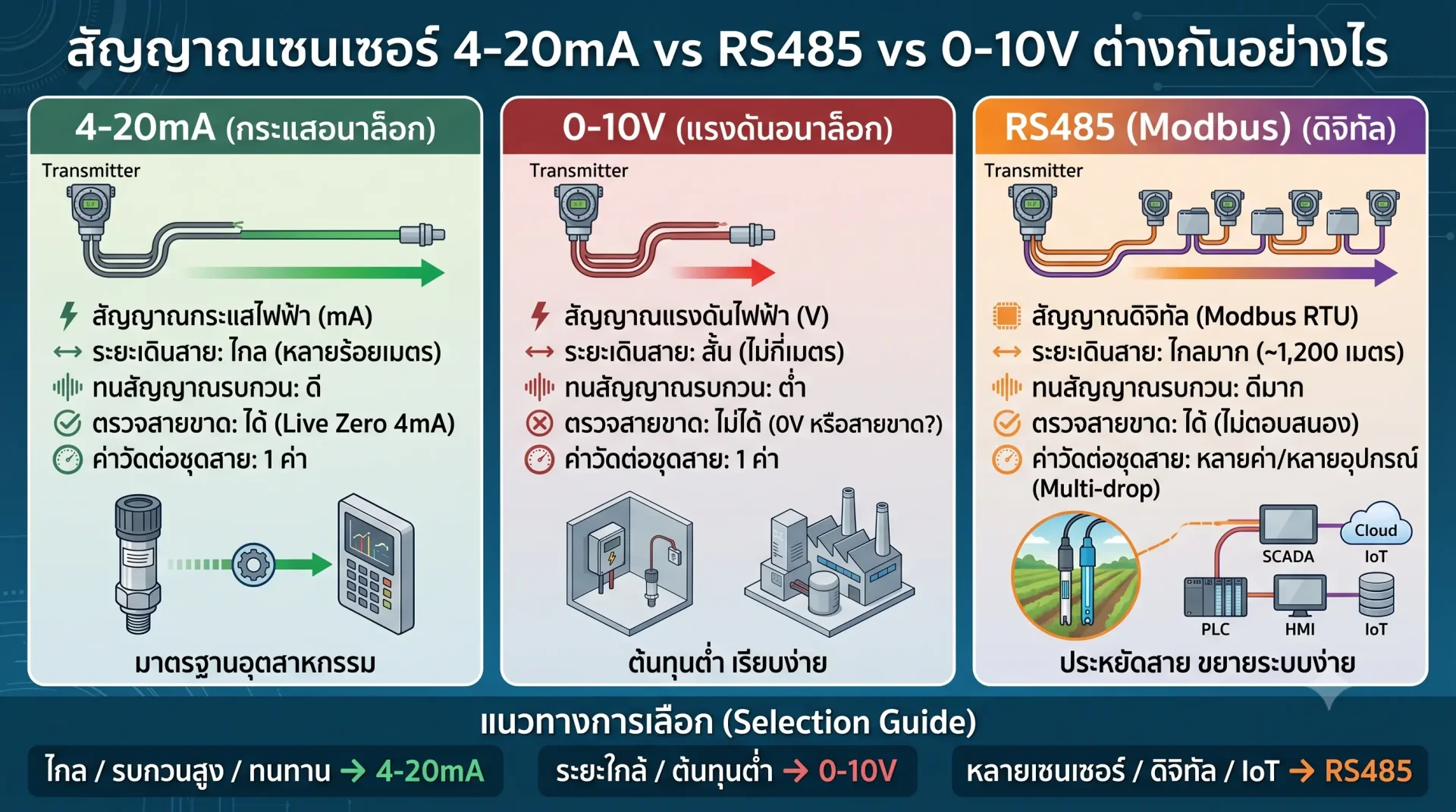
4-20mA vs. RS485 (Modbus) vs. 0-10V: What is the difference between these industrial sensor signals, and which one should you choose for your automation system? When selecting sensors for industrial automation or smart farming networks, one of the first and most critical questions to answer is deciding on the signal output type. The choice of signal directly impacts your wiring architecture, cable management, installation costs, and how the probes interface with controllers like PLCs or HMI panels. Industrial sensor outputs primarily fall into three main categories: 4-20mA (an analog current loop that resists noise and covers long distances), 0-10V (an analog voltage signal that is cost-effective but limited to short runs), and RS485 Modbus (a digital bus protocol capable of transmitting multiple parameters from multiple devices over a single cable chain). This article delivers a comprehensive comparison of these three signals, complete with a structural breakdown and deployment guidelines to help you optimize your system architecture.
What is a 4-20mA Signal?
A 4-20mA signal is an industrial analog current loop where a current of 4mA represents the minimum measured value (0%) and 20mA represents the maximum capacity (100%). A core engineering benefit of this design is the use of 4mA as a "Live Zero" baseline. Because the signal never drops to absolute zero during normal operation, the receiving controller can instantly distinguish between a genuine zero reading and a broken wire or dead sensor (which would register as a flat 0mA).
Because current remains constant throughout a closed loop regardless of cable length, 4-20mA signals are immune to voltage drops and highly resistant to electromagnetic interference (EMI). This makes the current loop exceptionally stable for long cable runs spanning several hundred meters, solidifying its place as the most widely used analog standard in the process industries. However, a key limitation is that each dedicated wire pair can only transmit a single measurement parameter.
What is a 0-10V Signal?
A 0-10V signal is an analog voltage output where 0V maps to the minimum scale value and 10V represents the maximum scale capacity (some variants utilize a 0-5V range instead). The primary advantages of 0-10V instrumentation are its absolute hardware simplicity and low manufacturing cost.
However, because it relies on voltage levels, the signal is highly vulnerable to voltage drops caused by internal wire resistance and susceptible to nearby electromagnetic noise when run over long distances. Consequently, 0-10V outputs are strictly recommended for short-distance applications, such as internal control cabinet wiring or runs limited to a few meters. Additionally, because its baseline rests at an absolute 0V, a receiving controller cannot automatically differentiate between a true zero reading and a severed signal wire.
What is an RS485 (Modbus) Signal?
RS485 is a digital communication hardware standard that transmits data over a twisted pair of signal wires (labeled A and B) utilizing differential signaling. This differential architecture provides extreme immunity against electrical noise and allows for reliable long-distance cable runs reaching up to 1,200 meters. When paired with the industry-standard Modbus RTU protocol, it supports multi-drop networking, enabling multiple sensors to be daisy-chained onto a single physical cable. Furthermore, a single digital probe can transmit multiple parameter readings simultaneously—such as a single multi-parameter water probe streaming pH, DO, and EC data over one shared wire set.
The core advantages of RS485 Modbus include dramatic savings on cable infrastructure, effortless system scalability, and absolute data precision that does not degrade over distance. This makes it an ideal fit for integration into PLCs, SCADA networks, and cloud-based IoT systems. Important engineering considerations include the necessity of assigning unique device slave IDs (Addresses), matching communication speeds (Baud Rates), and ensuring correct bus topology, such as installing a termination resistor at the end of the data line.
Technical Comparison Table: 4-20mA vs. 0-10V vs. RS485
- Signal Type: 4-20mA = Current (Analog) | 0-10V = Voltage (Analog) | RS485 = Digital
- Max Cable Distance: 4-20mA = Long (Hundreds of meters) | 0-10V = Short (A few meters) | RS485 = Very Long (~1,200 meters)
- Noise Resistance: 4-20mA = High | 0-10V = Low | RS485 = Excellent
- Channels per Wire Pair: 4-20mA = 1 Parameter | 0-10V = 1 Parameter | RS485 = Multiple Parameters & Multiple Devices
- Wire Break Detection: 4-20mA = Yes (Live Zero at 4mA) | 0-10V = No (Rests at 0V) | RS485 = Yes (Via timeout/no-response checks)
- Configuration Complexity: 4-20mA = Low | 0-10V = Low | RS485 = Medium (Requires address/baud rate setup)
- Best Fit Scenario: 4-20mA = Long distance, high noise, single value | 0-10V = Short distance, budget-friendly enclosure wiring | RS485 = Multi-sensor arrays, multi-parameter probes, digital IoT environments
How to Select the Optimal Signal Type
- Opt for 0-10V: When your sensor is mounted a short distance away within the same control enclosure, or for projects where circuit simplicity and raw budget savings are the highest priorities.
- Opt for 4-20mA: When routing cables over long industrial distances, through high-noise environments, or when you require automated wire-break fail-safes for single-parameter tracking like pressure or tank level monitoring.
- Opt for RS485 (Modbus): When deploying complex multi-sensor arrays, pulling multiple data types out of a single multi-parameter probe, scaling up digital automation networks, or connecting infrastructure directly to PLC/SCADA loops and IoT cloud frameworks.
In modern applications, many top-tier industrial sensors come equipped with dual 4-20mA and RS485 outputs out of the box, granting engineers maximum field flexibility. Selection should ultimately depend on your physical line distances, the total number of target parameters, and your central controller input type.
Interfacing Sensor Signals with PLCs and IoT Networks
Traditional analog signals (4-20mA and 0-10V) must be wired into dedicated PLC Analog Input modules, which digitize the incoming current or voltage curves. Conversely, digital RS485 Modbus signals bypass analog conversion entirely, plugging directly into the serial communication ports of a PLC or HMI panel.
Within the industrial ecosystems provided by E-POWER SERVICE, premium sensors from trusted brands like Supmea, CWT, and Rika offer extensive support for both analog loops and RS485 Modbus networks. This allows for seamless compatibility with major industrial PLCs—including XINJE, Haiwell, and LicOS units. These edge devices can then securely push your field datasets up to online IoT platforms like our ecloud cloud infrastructure, enabling remote data visualization and instant mobile threshold alerts from anywhere.
Frequently Asked Questions
Q: What is the main difference between 4-20mA and 0-10V?
A: A 4-20mA signal uses a current loop that remains constant across long cable runs, making it immune to voltage drops and highly resistant to electrical noise. A 0-10V signal uses voltage levels that are highly sensitive to noise and voltage line drops, limiting its use to short distances.
Q: Why do industrial 4-20mA current signals start at 4mA instead of 0mA?
A: Starting at 4mA creates a "Live Zero" baseline. If a cable snaps or a sensor fails, the current drops to 0mA, allowing the controller to immediately identify a hardware fault. If the baseline started at 0mA, the system could not tell the difference between a minimum reading and a broken wire.
Q: Is an RS485 Modbus digital signal always better than an analog loop?
A: It depends on your application. RS485 excels at daisy-chaining multiple sensors and streaming multiple data types over a single cable directly into digital automation architectures. Analog loops are simpler to implement and remain highly efficient for dedicated, single-parameter field tracking.