10 Smart Farm Sensors Every Modern Farm Needs: Matched to Your Crops and Livestock
SMART FARM GUIDE
10 Smart Farm Sensors Every Modern Farm Needs: Matched to Your Crops and Livestock
You don't need every sensor, but you do need the right ones. This guide shows which sensors your farm should start with and how each one raises yields or cuts costs.
Quick answer: which sensors does a smart farm use?
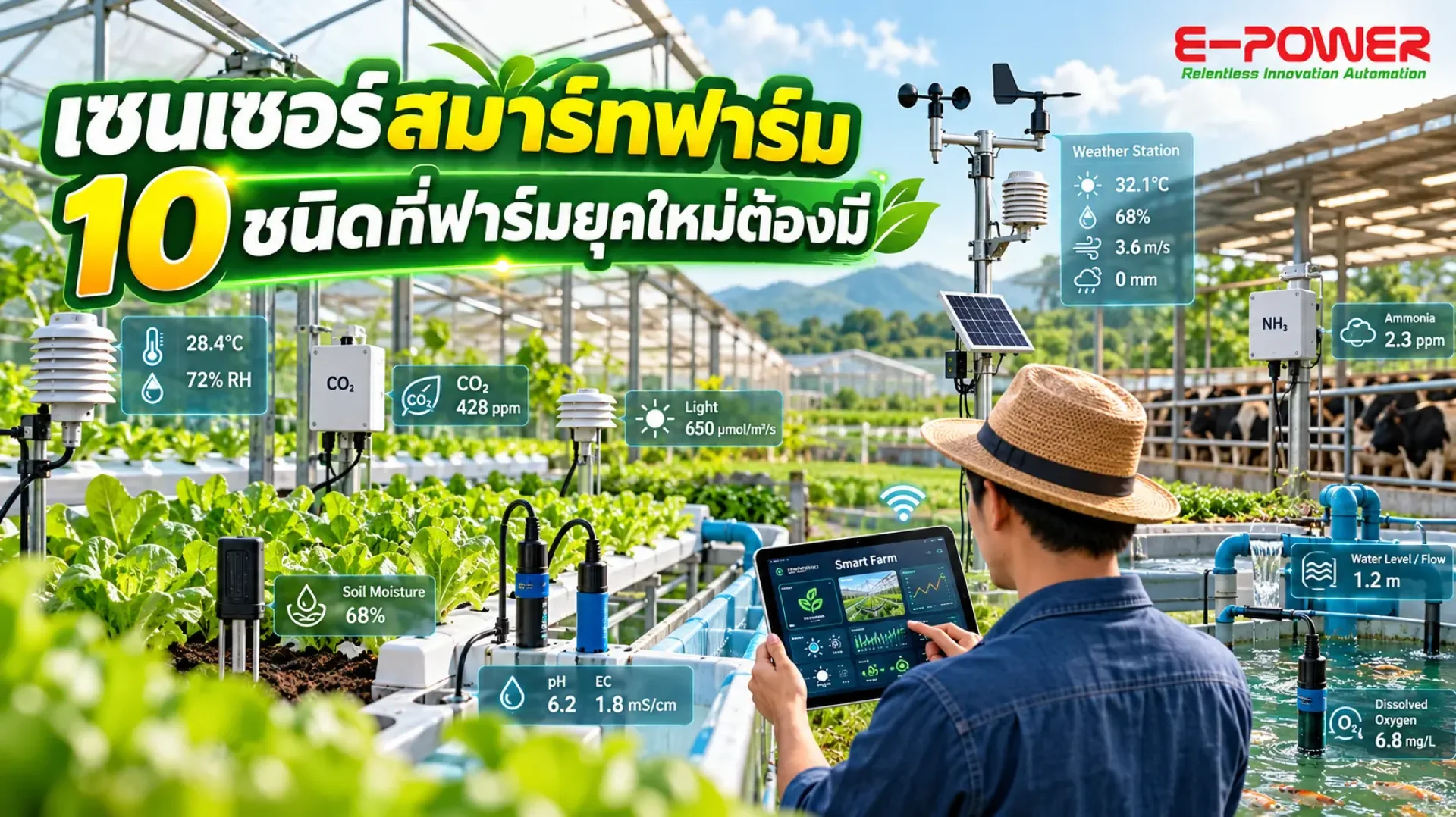
The most common smart farm sensors fall into 10 groups: air temperature and humidity, soil moisture, soil EC and nutrients, light and solar radiation, CO, water quality (pH/EC), dissolved oxygen, ammonia gas, weather stations (rain and wind), and water level or pressure. The right mix depends on the type of farm: hydroponic greenhouses focus on EC/pH and light, poultry houses on temperature, humidity, and ammonia, and shrimp ponds on dissolved oxygen.
QUICK SELECTION
Which sensors should each type of farm start with?
| Farm type | Start with | Add when scaling up |
| Hydroponic greenhouse | Temperature-humidity, water EC/pH, light | CO, water temperature |
| Orchards and field crops (e.g. durian) | Soil moisture, weather station (rain, wind, temperature) | Soil EC, solar radiation |
| Mushroom house | Temperature-humidity, CO | Light |
| Poultry house | Temperature-humidity, ammonia | CO, water pressure |
| Pig farm | Temperature-humidity, ammonia | CO, water level |
| Shrimp and fish ponds | Dissolved oxygen (DO), water temperature, pH | Water level, salinity |
IN DETAIL
10 smart farm sensors: what they measure and why they matter
01 Air temperature and humidity sensors
The baseline sensor every farm should have. It drives fans, misting systems, and cooling pads. Combining the two readings gives VPD, which shows whether plants are transpiring at a healthy rate.
Best for: all greenhouses, poultry houses, pig farms, mushroom houses
02 Soil moisture sensors
Show whether roots have enough water, enabling automatic irrigation that starts when soil dries and stops when it's sufficient, saving water and pump energy. For high-precision work, soil water potential sensors can be added.
Best for: orchards, field crops, open-field vegetables, drip irrigation
03 Soil EC and nutrient sensors
Soil EC indicates salt and fertilizer concentration, helping you fertilize precisely and watch for salinity. NPK sensors show nutrient trends, though periodic lab soil tests are still recommended to confirm values.
Best for: field crops, orchards, salinity-prone land
04 Light and solar radiation sensors
Measure the light plants receive, controlling greenhouse shade screens and enabling radiation-based irrigation, which matches plant demand far better than timers. A pyranometer measures total radiation, while a PAR sensor measures only the light plants use for photosynthesis.
Best for: hydroponic greenhouses, melons, tomatoes, ornamentals
RECOMMENDED FROM E-POWER
RIKA RK200-03 Pyranometer
Class A/B/C solar radiation sensor with RS485 / 420mA output, used for radiation-based irrigation View product
05 CO sensors
In closed greenhouses, CO is a raw material for photosynthesis, and the right enrichment speeds growth. In mushroom and livestock houses, high CO signals insufficient ventilation. Choose NDIR sensors that tolerate high humidity.
Best for: closed greenhouses, grow rooms, mushroom houses, livestock houses
06 Water quality sensors: pH and EC
The heart of hydroponics and fertigation. EC shows nutrient concentration and pH determines whether roots can absorb nutrients. Connected to an automatic fertigation system, they keep values on target at all times.
Best for: hydroponics, drip fertigation, aquaculture ponds
RECOMMENDED FROM E-POWER
E-POWER In-Line Fertigation System
Automatic fertigation with closed-loop PID EC/pH control and independent delivery to 5 greenhouses View product
RIKA RK500-12 pH Sensor
Online 014 pH sensor, IP68, with RS485 and 420mA outputs View product
JIRS PH/ORP-600 Controller
pH/ORP monitor and controller with relays for acid/alkali dosing pumps, 420mA and RS485 outputs View product
Supmea SUP-TDS210-C Conductivity Meter
Online conductivity meter for tracking nutrient concentration in water View product
07 Dissolved oxygen (DO) sensors
The most important sensor for aquaculture. DO usually bottoms out before dawn, and if it drops too far, fish and shrimp gasp at the surface and die en masse. Continuous monitoring with automatic aerator control reduces risk and power costs. Optical sensors need less maintenance than membrane types.
Best for: shrimp ponds, fish ponds, hatcheries
08 Ammonia gas (NH) sensors
Ammonia from manure slows growth and makes animals sick. General guidelines recommend staying below 2025 ppm. Using readings for automatic fan control keeps ventilation on time, even at night when fans are reduced to keep animals warm.
Best for: closed poultry houses, pig farms
09 Weather stations (rain, wind, temperature)
For open fields, rainfall data lets you skip irrigation when it has rained enough, wind data guides spraying decisions, and historical records help plan the next season.
Best for: orchards, field crops, large plots, agricultural research centers
RECOMMENDED FROM E-POWER
RIKA Weather Station
Complete weather station measuring temperature, humidity, wind, rain, and solar radiation View product
Electronic Rain Gauge
Tipping-bucket rain gauge that can calculate hourly rainfall intensity View product
Anemometer (wind sensor)
Measures wind speed and direction for spray planning and storm monitoring View product
10 Water level, pressure, and flow sensors
Look after the farm's water system: tank and pond levels, line pressure for inverter pump control, and actual water use. They help catch leaking pipes or faulty pumps early.
Best for: any farm with pumps, storage tanks, or holding ponds
RECOMMENDED FROM E-POWER
Supmea Electromagnetic Flowmeter LDG-A100
Electromagnetic flowmeter with ±0.5% accuracy for measuring actual water use View product
Radar Level Transmitter
Non-contact radar level sensor for tanks, ponds, and reservoirs View product
SELECTION CRITERIA
How to choose smart farm sensors that pay off
| Factor | Recommendation |
| Start with your costliest problem | For example, stock losses from low DO or crop damage from heat: install that sensor first |
| Output signal | RS485 Modbus-RTU lets many sensors share one cable and scales easily; 420mA suits existing PLCs |
| Durability | IP65 or higher for greenhouses; IP67IP68 for outdoor or submerged use |
| Power and connectivity | Solar power where there is no grid; 4G or LoRaWAN where there is no WiFi |
| Maintenance | Some sensors, such as pH and ammonia, need calibration or probe replacement; budget for it from the start |
| Lightning protection | Outdoor sensors on long cable runs need surge protection and proper grounding |
Good to know
Sensors pay off only when their data is used, through alerts when values go out of range and automatic control of fans, pumps, aerators, or fertigation. Farms that install sensors but never act on the readings rarely see the expected return.
E-POWER PRODUCTS
E-POWER smart farm equipment at a glance
E-POWER supplies sensors, controllers, and automation systems for farms, covering everything from measurement points to control and alerts.
| Product group | Models / systems | Used for |
| Light and weather | RIKA RK200-03 Pyranometer, RIKA Weather Station, Electronic Rain Gauge, Anemometer | Greenhouses, orchards, open fields |
| Water quality | RIKA RK500-12 pH, JIRS PH/ORP-600, Supmea SUP-TDS210-C | Hydroponics, aquaculture |
| Water systems | Supmea Electromagnetic Flowmeter, Radar Level Transmitter | Tanks, ponds, pump systems |
| Automation | E-POWER In-Line Fertigation System, FlowPLC, IoT Edge Gateway | All farm types |
For temperature-humidity, soil moisture, CO, dissolved oxygen, and ammonia sensors, ask E-POWER engineers for the model that best fits your site.
E-POWER SMART FARM
Connect every sensor on the farm in one system
- RS485 Modbus-RTU sensors installed in greenhouses, fields, livestock pens, or ponds
- FlowPLC / IoT Edge Gateway reads values and controls equipment automatically with Node-RED logic, even if the internet drops
- 4G or LoRaWAN data links for remote sites, with solar power
- Dashboards and alerts: view every point on mobile and receive LINE or Telegram notifications
- Room to grow: extend to automatic fertigation, inverter pump control, and greenhouse climate control
Frequently asked questions
Which sensors does a smart farm use?
Common ones include air temperature and humidity, soil moisture, soil EC, light, CO, water pH/EC, dissolved oxygen, ammonia, weather stations, and water level or pressure, chosen according to your crops and livestock.
Which sensor should a new smart farm install first?
Start with the one that solves your costliest problem, such as DO for shrimp ponds, temperature and humidity for greenhouses, or soil moisture for orchards, then expand.
Can sensors work on farms without power or internet?
Yes. Solar panels and batteries supply power, and data is sent over 4G or LoRaWAN.
RS485 or 420mA: which should I choose?
RS485 Modbus-RTU connects many sensors on one cable and scales easily, while 420mA suits connecting to an existing PLC or controller.
How should smart farm sensors be maintained?
Clean probes according to site conditions, calibrate water quality and gas sensors at the manufacturer's recommended intervals, and check signal cables after storms.
Not sure which sensor your farm should start with?
E-POWER engineers can assess your site, recommend sensors that match your crops and livestock, and design a smart farm system that grows with you.
Talk to us on LINE @epower info@epower.co.thTel. +66 81-559-5145 · YouTube: Epower Service · TikTok: epowerservice_