What Is a PT100? PT100 vs Thermocouple and How to Choose the Right Temperature Sensor
TEMPERATURE MEASUREMENT GUIDE
What Is a PT100? PT100 vs Thermocouple and How to Choose the Right Temperature Sensor
A comparison of the two most widely used industrial temperature sensors: range, accuracy, durability, and correct wiring.
Quick answer
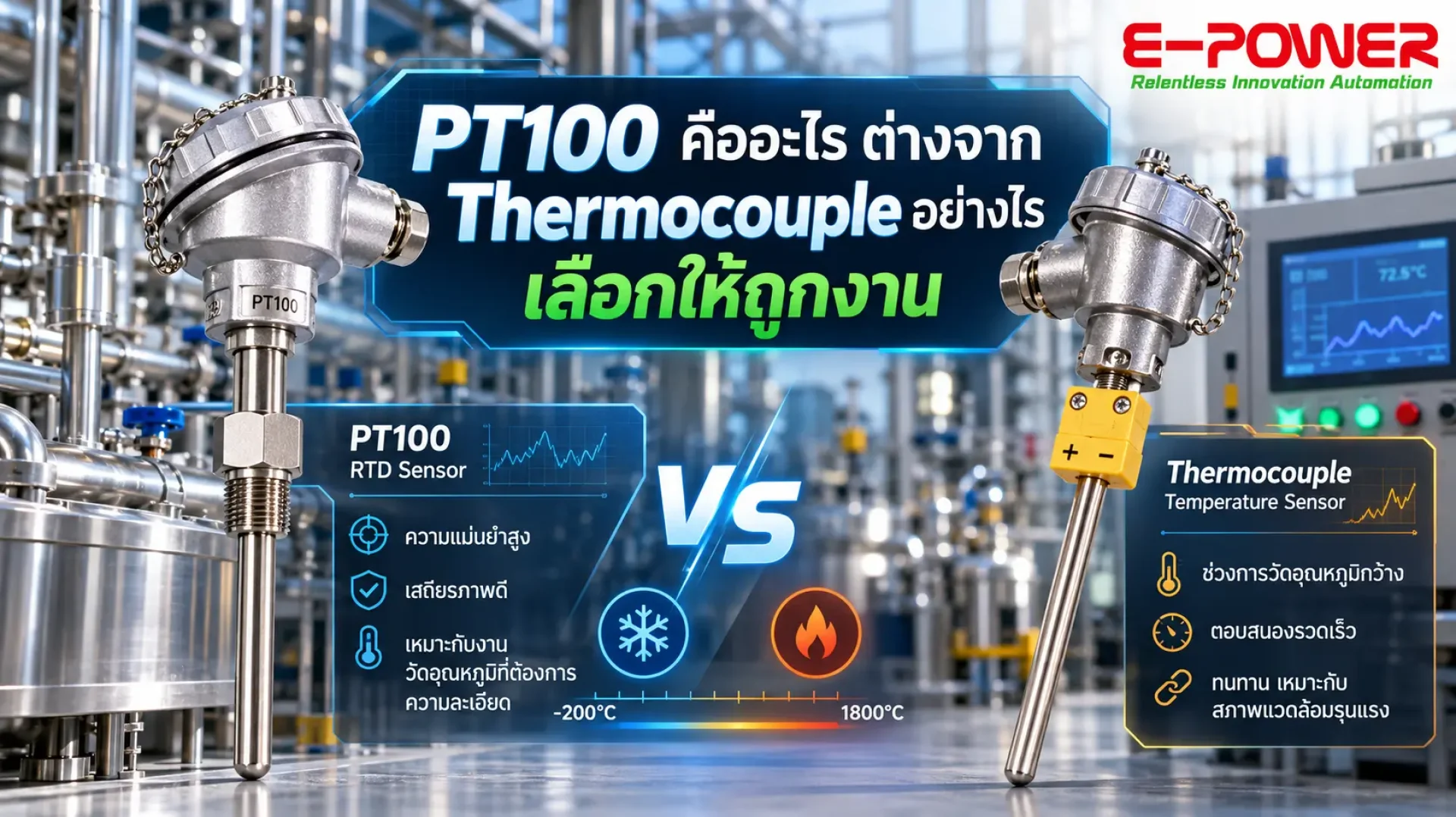
A PT100 is an RTD temperature sensor made with a platinum wire or film that has a resistance of 100 ohms at 0°C, increasing as temperature rises. It offers high accuracy and stability and suits applications up to about 500°C. A thermocouple uses two different metals to generate a voltage that varies with temperature. It measures far higher temperatures, is rugged, and responds quickly, but is less accurate.
To measure above 500°C, use a thermocouple. Type K typically covers up to about 1,200°C, while Types R, S, or B are used for hotter furnaces.
01
What is a PT100 and how does it work?
A PT100 is a type of RTD (Resistance Temperature Detector). "PT" is the chemical symbol for platinum, and "100" is its resistance of 100 ohms at 0°C. As temperature rises, resistance increases by about 0.385 ohms per °C according to IEC 60751. The instrument passes a small current through the sensor, reads the resistance, and converts it to temperature.
| Temperature | Approximate PT100 resistance |
| 0°C | 100.00 Ω |
| 50°C | 119.40 Ω |
| 100°C | 138.51 Ω |
| 200°C | 175.86 Ω |
Besides the PT100, there is the PT1000, with 1,000 ohms at 0°C. It is far less affected by lead-wire resistance, making it popular for long cable runs and compact devices.
02
What is a thermocouple and how does it work?
A thermocouple consists of two wires of different metals joined at one end. When the measuring end (hot junction) and the instrument end (cold junction) are at different temperatures, a small millivolt-level voltage is produced through the Seebeck effect. The instrument must also measure the temperature at the connection point, known as cold junction compensation, to calculate the true temperature at the tip.
Common thermocouple types
| Type | Approximate range | Typical applications |
| K | -200 to 1,200°C | Most widely used: ovens, furnaces, boilers, general purpose |
| J | 0 to 750°C | Plastic injection molding, older machinery |
| T | -200 to 350°C | Low temperatures, cold rooms, food processing |
| N | -200 to 1,300°C | Alternative to Type K when long-term stability at high temperature matters |
| R, S | 0 to about 1,600°C | Ceramic kilns, glass and metal melting furnaces |
| B | About 600 to 1,700°C | Very high-temperature furnaces and special melting processes |
Actual operating ranges depend on wire size, sheath, and atmosphere. Always check the manufacturer's specifications.
03
PT100 vs thermocouple: what's the difference?
| Topic | PT100 (RTD) | Thermocouple |
| Principle | Resistance changes with temperature | Two metals generate a voltage |
| Typical range | -200 to about 500°C (some models higher) | -200 to nearly 1,800°C depending on type |
| Accuracy | High, e.g. Class A about ±0.15°C at 0°C | Moderate, e.g. Type K Class 2 about ±2.5°C or 0.75% |
| Long-term stability | Excellent, minimal drift | Can drift after long use at high temperature |
| Response time | Slower | Fast, especially with small tips |
| Vibration resistance | Moderate; thin-film is tougher than wire-wound | Good |
| Wiring | Standard copper wire, 3- or 4-wire | Requires extension or compensating cable of the matching type |
| Cost | Higher | Lower (except precious-metal Types R, S, B) |
04
Which one should you choose?
Choose a PT100 when
- Temperatures stay below about 500°C
- You need high accuracy and long-term stability
- Food, pharma, cold rooms, HVAC, chillers, cooling water
- Traceability and regular calibration are required
Choose a thermocouple when
- Temperatures exceed 500°C
- You need fast response or a very small measuring point
- There is heavy vibration or a harsh environment
- Ovens, furnaces, boilers, flue stacks, injection molding
What sensor should I use above 500°C?
Use a thermocouple. For 5001,200°C, Type K is the usual choice, or Type N for better long-term stability. For furnaces above 1,200°C, use Type R, S, or B with a ceramic protection tube. For moving objects or surfaces that can't be touched, consider an infrared thermometer instead.
05
PT100 2-wire, 3-wire, and 4-wire connections
Because a PT100 measures resistance, the resistance of the lead wires is added to the reading. The wiring method therefore directly affects accuracy.
| Type | Characteristics | Best for |
| 2-wire | Lead resistance is included in the reading, so it reads high | Very short leads or a head-mounted transmitter |
| 3-wire | Compensates for lead resistance when all three wires are identical | Industrial standard |
| 4-wire | Virtually eliminates lead effects; the most accurate | Laboratories and calibration |
Example 2-wire error
A 10 m run of 0.5 mm² copper wire has about 0.34 ohms per conductor, or roughly 0.69 ohms out and back. That makes the reading about 1.8°C too high, several times the accuracy of the PT100 itself.
06
Common mistakes on site
- Extending a thermocouple with copper wire creates new metal junctions and errors. Use compensating or extension cable that matches the thermocouple type
- Reversed thermocouple polarity makes the reading move the wrong way as temperature changes. Check positive and negative against the color code of the standard in use
- Wrong type configured in the instrument, such as a Type J sensor set as Type K, gives errors across the whole range
- Insufficient immersion depth lets heat conduct out through the sheath. Immerse as deep as the manufacturer recommends, and use a thermowell in pressurized or high-flow pipes
- Long millivolt signal runs next to power cables pick up noise easily. Convert to 420mA or RS485 close to the measuring point
07
Signal conversion and IoT integration
In industry, a temperature transmitter is usually fitted in the sensor head or a nearby enclosure to convert resistance or millivolts into a 420mA or RS485 Modbus-RTU signal that resists noise and travels long distances.
E-POWER's FlowPLC and IoT Edge Gateway read temperature transmitters directly, control heaters, fans, or valves with Node-RED logic, log historical trends, and send LINE or Telegram alerts when temperatures go out of range. They are well suited to ovens, cold rooms, chillers, and factory processes.
Frequently asked questions
What is a PT100?
A platinum RTD temperature sensor with 100 ohms at 0°C, increasing by about 0.385 ohms per °C, known for high accuracy.
What sensor should I use above 500°C?
A thermocouple: Type K or N up to about 1,2001,300°C, and Type R, S, or B for higher temperatures.
What is the difference between PT100 and PT1000?
A PT1000 has 1,000 ohms at 0°C and is less affected by lead resistance, so it suits long cable runs or 2-wire connections.
Can I extend a thermocouple with ordinary wire?
No. Use compensating cable of the same type as the thermocouple, or new metal junctions will cause reading errors.
How many wires should a PT100 use?
3-wire for general industrial use, 4-wire for maximum accuracy, and 2-wire only with very short leads or a head-mounted transmitter.
Not sure which temperature sensor your application needs?
E-POWER engineers can help you choose a PT100 or thermocouple for your temperature range and site, and design signal conversion and monitoring integration.
Talk to us on LINE @epower info@epower.co.thTel. +66 81-559-5145 · YouTube: Epower Service · TikTok: epowerservice_