Water Salinity Sensors: Monitoring Saltwater Intrusion into Water Supplies and Aquaculture Ponds
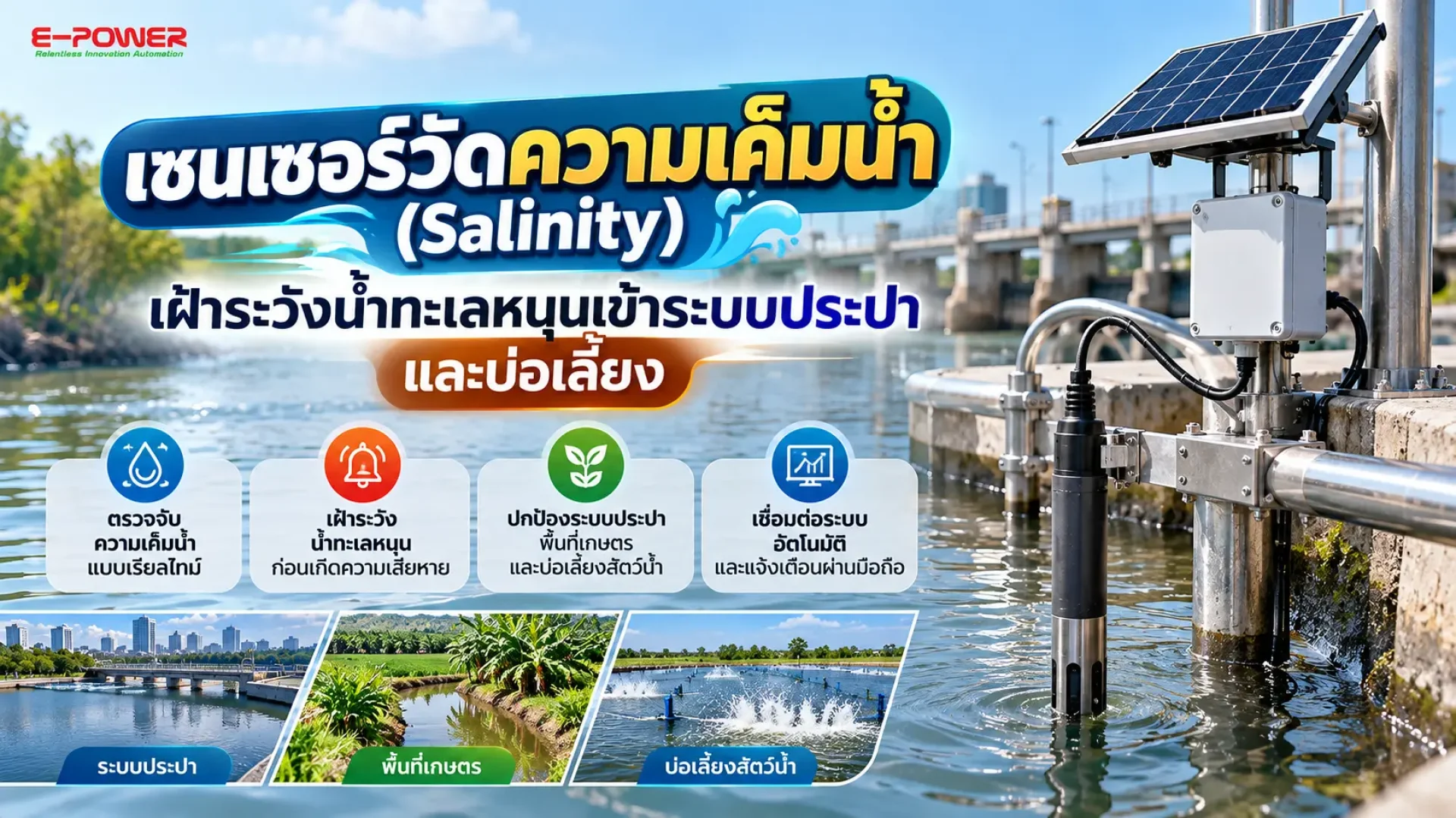
WATER QUALITY MONITORING
Water Salinity Sensors: Monitoring Saltwater Intrusion into Water Supplies and Aquaculture Ponds
Every dry season, seawater pushes further up rivers, affecting raw water for tap water production, farmland, and aquaculture ponds. Continuous salinity monitoring is how operators respond in time, before damage is done.
A water salinity sensor is essential for water utilities, factories drawing river water, riverside farms, and aquaculture operations. Salinity can change hour by hour with the tides, so a once-a-day manual check may miss the saltiest period. This article explains what salinity level becomes a problem, how a water salinity sensor works, and how to install it for accurate early warning.
Quick answer: what salinity is too high for tap water production?
Monitoring guidelines used by Thai water agencies indicate that raw water with salinity above 0.25 grams per liter begins to affect the taste and quality of tap water. Above 0.5 g/L, it may affect people who must limit salt, such as kidney and high blood pressure patients, and above 2 g/L it harms most crops. A water salinity sensor detects rising levels in real time, so pumping can stop during salty periods and resume when the water is fresher.
01
What is saltwater intrusion, and why monitor it with a water salinity sensor?
Saltwater intrusion happens when little fresh water flows down from upstream, especially in the dry season, letting seawater push salt further up the river. During the highest spring tides of the month, salinity rises even higher and travels further inland.
Water supply
Salty raw water makes tap water taste brackish, and conventional treatment can't remove the salt
Farmland
Riverside fruit orchards such as durian and pomelo suffer leaf burn and can die from salty water
Aquaculture ponds
Rapid salinity changes stress fish and shrimp, cut feeding, and can cause deaths
Factories
Salty water accelerates corrosion in boilers, cooling systems, and metal piping
02
Salinity levels to know
| Salinity (g/L) | Impact |
| Below 0.25 | Fresh water, suitable for normal tap water production |
| 0.25 and above | Starts to affect tap water taste and quality; stop raw water intake or dilute |
| 0.5 and above | May affect people on low-sodium diets, such as kidney and high blood pressure patients |
| 2 and above | Harmful to most crops; should not be used for irrigation |
| About 35 | Average salinity of seawater |
These are general monitoring guidelines. Each utility or plant may set its own control limits according to the water quality standards it must meet.
Suitable salinity for aquaculture ponds
Each species tolerates salinity differently. Pacific white shrimp can be farmed across a wide range but often grow best at around 10-25 parts per thousand (ppt), while many freshwater fish become stressed with only a small rise. More dangerous than high salinity itself is rapid change, for example after heavy rain or when pumping in water from a source with different salinity. Continuous monitoring lets you adjust the water before the stock goes into shock.
03
How does a water salinity sensor work?
Dissolved salt splits into ions that conduct electricity, so the saltier the water, the better it conducts. A water salinity sensor measures electrical conductivity (EC) together with temperature, then calculates salinity using a standard formula. Temperature compensation is critical because conductivity changes by roughly 2% per degree Celsius.
| Unit | Meaning |
| g/L or ppt | Grams of salt per liter, or parts per thousand; common in water supply and aquaculture |
| PSU | Practical salinity unit, calculated from conductivity and used in oceanography; close to ppt |
| mS/cm or µS/cm | Electrical conductivity; seawater is about 50-55 mS/cm, typical fresh water below 1 mS/cm |
Types of water salinity sensor probes
2-electrode
Economical, suited to fresh and low-salinity brackish water, but drifts when fouled by sediment
4-electrode
Wide range from fresh water to seawater with better fouling resistance; popular for river monitoring
Inductive (toroidal)
No metal electrodes touch the water; resists sediment and corrosion, ideal for high salinity and wastewater
04
Installing a water salinity sensor for accurate early warning
- Mount at the same depth as the intake pipe. Salt water is denser than fresh water, so it often flows along the bottom as a salt wedge. The surface may be fresh while the riverbed is already salty. Where possible, measure at two depths: near the surface and near the bottom
- Use a perforated protective tube fixed to a pole or floating pontoon, keeping debris and water hyacinth away and following water level changes
- Choose a point with flow, not a stagnant corner, so readings represent the water actually being pumped
- Plan cleaning: sediment, algae, and barnacles on the probe make readings read low. Clean on schedule and calibrate with standard solutions
- Protect against lightning and surges: riverside stations sit in open areas, so fit surge protection on RS485 and power lines
Tip: use tide patterns to guide pumping
Salinity usually peaks shortly after high tide and is lowest around low tide. After logging a water salinity sensor continuously for several days, a clear daily pattern emerges, so you can pump into storage ponds or reservoirs when water is freshest and stop when it exceeds your limit.
05
How to choose a water salinity sensor
| Factor | Recommendation |
| Measuring range | For saltwater intrusion monitoring, cover fresh to brackish water with good resolution below 1 g/L |
| Temperature compensation | Built-in temperature sensor with automatic compensation is essential |
| Materials | Resistant to salt and corrosion, such as titanium, graphite, or engineering plastics |
| Ingress protection | IP68 for continuous immersion |
| Output signal | RS485 Modbus-RTU sends salinity, conductivity, and temperature on one cable; 4-20mA suits existing PLCs |
06
Real-time salinity monitoring stations from E-POWER
E-POWER is a distributor of RIKA and Supmea water quality sensors and designs self-sufficient monitoring stations for riverside sites.
- Water salinity, conductivity, and temperature sensors over RS485 Modbus-RTU, installable at multiple depths
- FlowPLC / IoT Edge Gateway logs data locally, runs on solar power, and transmits over 4G or LoRaWAN
- Automatic pump control: stops raw water intake when salinity exceeds the limit and resumes when it falls
- Dashboards and LINE or Telegram alerts: track salinity against tide cycles and get instant notifications when levels rise
Frequently asked questions about water salinity sensors
What salinity is too high for tap water production?
General monitoring guidelines treat above 0.25 g/L as starting to affect tap water quality, and above 0.5 g/L as potentially affecting people on low-sodium diets.
How does a water salinity sensor work?
It measures the water's electrical conductivity together with temperature and calculates salinity, since dissolved salt makes water conduct electricity better.
What is the difference between salinity and EC?
EC is the directly measured electrical conductivity, while salinity is the salt content calculated from EC and temperature. Most sensors report both.
At what depth should the sensor be installed?
At the same depth as the intake pipe, since salt water tends to sit in the lower layer. Ideally, measure both near the surface and near the riverbed.
Can a salinity station work without grid power?
Yes, using solar panels and batteries with an IoT gateway that transmits over 4G or LoRaWAN.
Need to detect saltwater intrusion before it reaches your water system?
E-POWER engineers can design a water salinity monitoring station, from sensor selection, solar power, and communications to pump control and mobile alerts.
Talk to us on LINE @epower info@epower.co.thTel. +66 81-559-5145 · YouTube: Epower Service · TikTok: epowerservice_