Smart Pig Farm : Controlling House Temperature by Pig Age
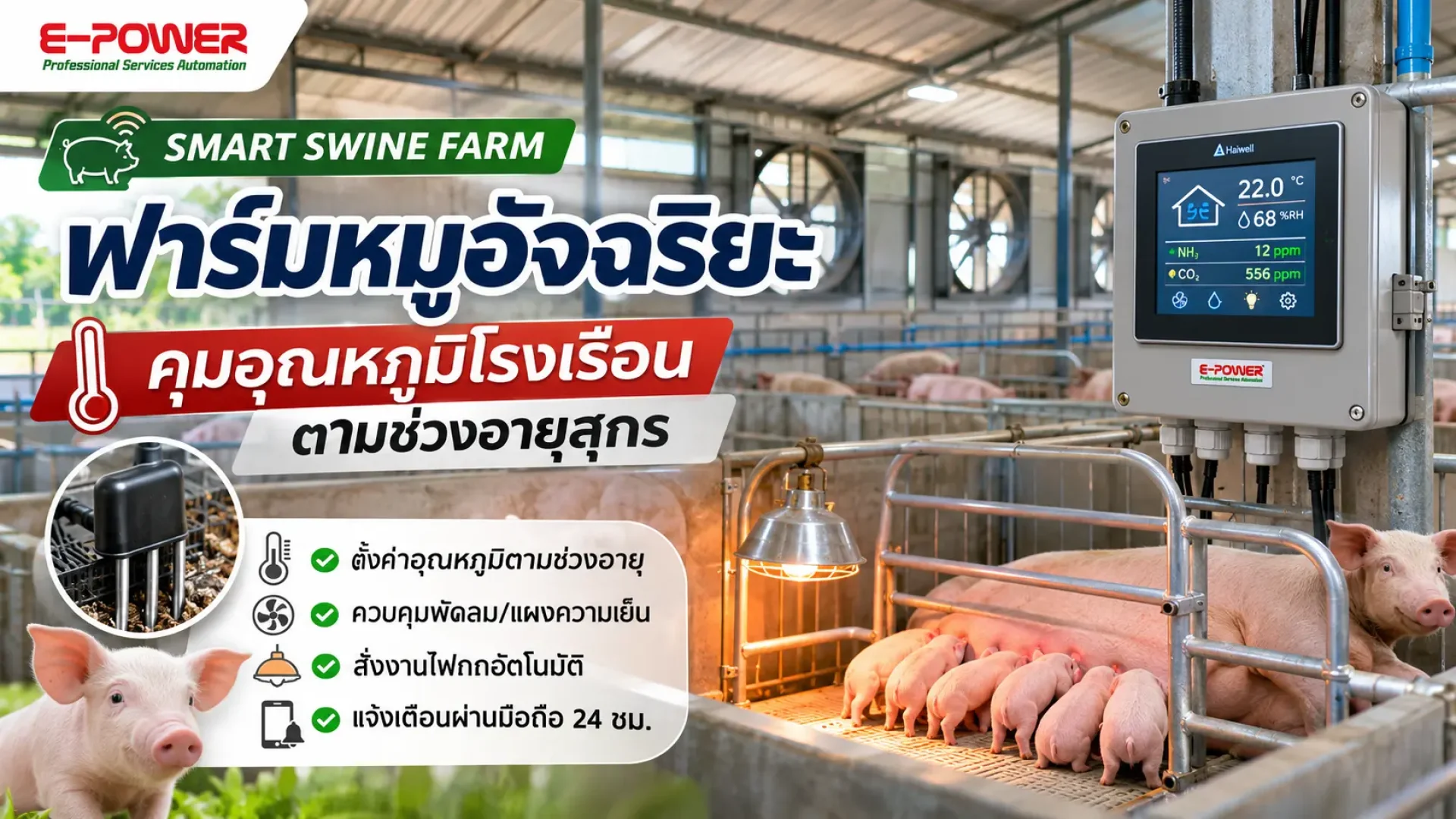
SMART SWINE FARM
Smart Pig Farm: Controlling House Temperature by Pig Age
Piglets need warmth while sows and finishers need cooling. Matching temperature to each age group is the key to survival rates, growth, and farm profit.
A smart pig farm uses sensors and automatic control to manage the house environment 24 hours a day. The challenge in pig production is that each age group needs very different temperatures, especially in the farrowing room, where piglets need heat but sows need cool air. This article summarizes the right temperature for each stage and how automation controls it more precisely than manual adjustment.
Quick answer: what temperature do piglets need?
Newborn piglets need about 32-35°C in the creep area during the first week, then about 2°C less each week, while sows in the farrowing pen are comfortable at around 18-22°C, so two zones must be controlled at once. After weaning, piglets need about 26-30°C, while finishers and breeding stock are comfortable at around 16-22°C. A smart pig farm uses multiple sensors to control heat lamps, fans, and cooling pads automatically for each stage.
01
Recommended temperatures by pig age
| Stage | Target temperature | Notes |
| Newborn to 1 week | 32-35°C (creep) | Produce little body heat, chill easily, and risk being crushed when huddling against the sow |
| Piglets 2-4 weeks | 28-32°C (creep) | Reduce heat lamp output with age |
| Lactating sows | 18-22°C | Too much heat cuts feed intake and milk yield, slowing piglet growth |
| Weaners (nursery) | 26-30°C down to 22-24°C | Weaning is stressful; keep temperature steady and drafts away |
| Growers | 20-24°C | Generate more of their own heat |
| Finishers | 18-22°C | Overheat most easily; heat stress reduces feed intake |
| Gestating sows and boars | 16-20°C | Heat affects conception rates and semen quality |
These are general guidelines. In closed houses in tropical climates, farms may set slightly higher values depending on cooling capacity. Use them together with veterinary advice and actual pig behavior. On a smart pig farm, these values become an age-based temperature curve that the system adjusts automatically every day.
Reading pig behavior: too hot or too cold?
Signs of cold
Huddling in piles, shivering, raised hair, piglets crowding too close to the sow
Signs of heat
Rapid breathing, lying spread apart, lying in wet areas, eating less
02
Why do pigs tolerate heat so poorly?
Pigs have very few sweat glands, so they shed heat mainly through breathing and by lying on cool or wet floors. In hot, humid climates, finishers and sows easily suffer heat stress, which reduces feed intake, slows growth, worsens feed conversion, lowers sow milk production, and reduces boar semen quality. High humidity also makes it harder to lose heat through breathing, so a smart pig farm must monitor temperature and humidity together.
03
The farrowing room: controlling two temperature zones
The farrowing room is the hardest area on a pig farm, and where a smart pig farm pays off most, because piglets and sows need temperatures more than 10°C apart in adjoining spaces. A good system splits control into two zones.
| Zone | Equipment | Controlled by |
| Piglet creep | Infrared heat lamps or heated floor mats | Creep temperature sensor, output reduced with piglet age |
| Sow | Fans, cooling pads, and drip cooling on the sow's neck | Room temperature and humidity sensors |
Save energy on heat lamps
Heat lamps running at full power all the time are a major electricity cost and can overheat the room, stressing the sow. Using creep sensors with automatic control, switching on only when needed and reducing output as piglets grow, saves power and keeps the room right for the sow.
04
Sensors every smart pig farm needs
Precise control starts with accurate measurement, so a smart pig farm combines several types of sensors:
| Sensor | Purpose |
| Multi-point temperature-humidity | Mounted at pig height at the front, middle, and rear of the house, plus at piglet creeps |
| Ammonia (NH3) | Gas from manure and urine that irritates airways; keep below about 20-25 ppm |
| CO2 | Shows whether minimum ventilation is sufficient, especially in nurseries kept closed for warmth |
| Water meter | An abnormal drop in drinking water is an early sign of illness or blocked nipple drinkers |
| Power failure detection and energy meter | Instant alerts on power outages, and tracking of fan, heat lamp, and pump energy use |
05
What can automation do on a smart pig farm?
- Age-based temperature curves: heat lamp and nursery setpoints drop automatically each day, with no manual changes
- Staged fans with inverter speed control, matching ventilation to heat load and saving more energy than on/off control
- Humidity-aware cooling pads and drip cooling that remove heat without making the house too damp
- More ventilation when ammonia rises, even when temperature isn't high
- Mobile alerts for abnormal temperature, falling water intake, or power failure, which can cause severe losses in a closed house within a short time
- Batch-by-batch records comparing environment with survival, weight, and feed conversion to improve the next batch
06
E-POWER smart pig farm system
- RS485 Modbus-RTU sensors for temperature, humidity, ammonia, and CO2 at multiple points, plus water and energy meters
- FlowPLC / IoT Edge Gateway or Haiwell PLC controls fans, inverters, cooling pads, drip cooling, and heat lamps, and keeps working if the internet drops
- HMI screen at the house entrance so stockpersons can view readings and set age-based temperature curves easily
- Dashboards and LINE or Telegram alerts: monitor every house on mobile 24 hours a day
- Retrofit-ready: add to existing fans and equipment without building new houses
Frequently asked questions about smart pig farms
What temperature do piglets need?
Newborn piglets need about 32-35°C in the creep area in the first week, dropping about 2°C per week. After weaning, around 26-30°C.
What is a smart pig farm?
A pig farm that uses sensors and automatic control to manage temperature, humidity, and air quality in the house, with data logging and mobile alerts.
How do sow and piglet temperature needs differ?
Sows in the farrowing pen are comfortable at about 18-22°C, while piglets need 32-35°C, so piglets get spot heating from lamps or mats while the room is cooled for the sow.
What temperature should finishing pigs be kept at?
Generally about 18-22°C. Finishers overheat most easily, and heat reduces feed intake and growth.
Can automation be added to an existing pig house?
Yes. Sensors and controllers can be added to existing fans, cooling pads, and heat lamps without building a new house.
Ready to turn your pig houses into a smart pig farm?
E-POWER engineers can survey your houses, design sensor and automatic control systems, and install alerts for your farm.
Talk to us on LINE @epower info@epower.co.thTel. +66 81-559-5145 · YouTube: Epower Service · TikTok: epowerservice_